Writing on conflict, systems,
and the humans inside them
IDEAS & PERSPECTIVES
I write about conflict not as a problem to be solved, but as a signal worth listening to. These essays and reflections are for practitioners, organizational leaders, and anyone navigating difficult dynamics with intention.
A low-volume, high-quality newsletter on conflict, systems, and the human dimensions of change. No noise — just ideas worth sitting with.
Get new writing in your inbox
No spam, ever. Unsubscribe anytime.

When Should an Organization Bring In Outside Conflict Support?
Outside conflict support is worth considering when the current approach stops working. Six signs, four kinds of support, and questions to ask first.
By Jodie Marynowski, M.A. in Negotiation, Conflict Resolution and Peacebuilding. Conflict Resolution Strategist and Educator, Humboldt County, California.
Short answer: bring in outside conflict support when the current way of handling the conflict has stopped working, even if nothing has become formal, public, or extreme. You don't have to wait for a complaint, a resignation, or a board blowup to ask for help.
That sounds obvious. In practice, most teams wait a long time.
They wait because the issue doesn't seem serious enough. Nobody wants to overreact. Leaders hope one more conversation, one more check-in, will settle things down.
Sometimes it does.
But sometimes the same tension keeps coming back in a new outfit. People get more careful and less honest. Managers spend more of the week absorbing frustration in private. Meetings sound agreeable and nothing changes afterward. Trust thins out around the process while everyone stays perfectly polite.
That's the moment worth noticing. Not because the organization failed, and not because the next step has to be formal.
The better question isn't "is this bad enough?"
Leaders ask me some version of that question all the time. Is this bad enough to bring someone in?
I understand the hesitation. Outside support raises real questions about cost, confidentiality, and authority. Underneath most of it sits a quieter worry: that asking for help will make the conflict look bigger than it is.
But "bad enough" is a hard test to pass, and it keeps people waiting for damage they could have prevented. A more useful question:
What is this conflict costing us to keep handling it the same way?
That cost shows up in turnover, in stalled decisions, and in the emotional weight carried by a few trusted people who never asked for it. The question isn't whether the conflict is dramatic. It's whether the current approach is working.
What kind of conflict problem is this?
Before deciding what help to bring in, it helps to sort what you're facing. Most organizational conflict is a mix of three things.
A clarity problem. People don't share the same understanding of roles, authority, expectations, or next steps. It looks like personal tension, but something was never made clear, so people fill the gaps themselves and the guesses collide. This needs structure: roles, decision pathways, meeting agreements, follow-through.
A relationship pattern. The issue is less about one decision and more about how people have learned to interact. Avoidance, defensiveness, repair attempts that don't hold, or enough history that small comments land loaded. This may need a structured conversation, coaching, mediation, or facilitated repair.
A system problem. The organization itself is producing the pattern. Nobody knows where to raise a concern early. Managers absorb conflict without support. Formal processes exist but feel too heavy for a small worry. Board members aren't sure what belongs in governance, what belongs in management, and what never gets started. This needs conflict systems consulting, training, or process design, not another hard conversation between the same two people.
The sorting matters because the wrong container makes conflict worse. A team asks for mediation when the real need is role clarity. An organization requests training when the actual problem is that nobody trusts what happens after a concern gets raised.
Six signs internal handling may not be enough
Every organization has conflict. A healthy one isn't a place where people never disagree. It's a place where disagreement has somewhere constructive to go.
1. The same issue keeps resurfacing. The topic changes, the pattern feels familiar. A manager thinks something is settled and hears it again a month later from someone else. Repetition usually means the visible issue is getting treated while the pattern underneath is missed.
2. People are avoiding the conversations that matter. Avoidance doesn't always look like avoidance. Sometimes it looks like professionalism. People stay cordial, copy the right names on email, say "that's fine," then move the real concern into side conversations and private texts. People rarely avoid conflict because they lack values. They avoid it because they're afraid clarity will cost them belonging, standing, or safety.
3. Managers have become informal mediators. They listen to one person's frustration, then another's. They translate intent, smooth tension, and keep the work moving. Some of that is leadership. But when a manager spends more of the week absorbing conflict than leading the work, that isn't a personal weakness. It's a role problem wearing a personal face.
4. Feedback feels risky or loaded. A routine comment gets heard as criticism. A reasonable request feels like blame. When people are already braced for threat, even a well-intended conversation turns difficult fast.
5. Meetings produce agreement but no movement. People nod, a next step gets named, and the same behavior continues. That happens when the meeting never arrived at the real issue, or when the group has no way to name disagreement without making it personal.
6. People have lost trust in the process. This is the most important one. They may still respect their leaders and care about the mission. They just no longer believe concerns will be handled fairly or early enough. When process trust goes, people pick other routes: silence, side conversations, formal complaints, or quietly looking elsewhere.
What can an outsider do that internal leaders can't?
Internal leaders know the people and the history, and that context is worth a great deal. Being inside the system also has limits. A leader may be part of the conflict without meaning to be, or be seen as having already chosen a side, or be so used to the pattern that it's hard to see at all.
An outside role can hold neutral structure, name a pattern without being tangled in the politics, and slow down a conversation that usually moves too fast. It can also leave people with shared language for the next conflict, not only this one. That doesn't replace leadership. It gives leadership something to work with.
What kind of outside conflict support fits?
Outside conflict support isn't one thing. Four common forms:
Facilitation helps when a group needs a structured conversation about a hard topic, a decision, or a transition.
Training helps when people need shared skills for feedback, de-escalation, difficult conversations, and repair.
Conflict systems consulting helps when an organization needs better pathways, norms, roles, and processes for handling conflict before it escalates.
Mediation helps when specific people are ready for a structured conversation with each other and the situation is appropriate for that process.
Often the first step is simply sorting which one fits. That conversation alone can keep an organization from choosing a process that's too small, too formal, too late, or aimed at the wrong problem.
What outside conflict support is not
It isn't therapy, legal advice, or an HR investigation. It isn't a substitute for formal reporting, safety procedures, or real accountability, and it isn't a guarantee that everyone will agree. Some situations need legal guidance, a formal investigation, or safety planning, and conflict support shouldn't blur that line.
But most organizational conflict lives in the space before and around the formal processes. Repeated tension. Strained trust. Unclear expectations. Leadership overload. That's where this work earns its keep.
Questions to ask before you wait longer
Start with the cost question: what is this conflict costing us to keep handling it the same way? Then:
Is this repeating, or is it a one-time issue?
What have we already tried, and what actually changed afterward?
Who is carrying the cost of the current approach?
Is this a clarity problem, a relationship pattern, a system problem, or some mix of all three?
If several of those land, the issue doesn't need to become a crisis before it deserves support. By the time a conflict becomes formal or public, people have built stories about each other, positions have hardened, and the organization has spent months managing the impact without ever naming the pattern.
Bringing in help earlier isn't an admission that something broke. It's a way of saying this matters enough to handle with care. Most of the time, the conversation an organization needs is already trying to happen. The work is building a path it can travel.
If this is showing up in your organization, I work with teams, boards, and workplaces that need a clearer path forward. You can explore services or start the conversation when you're ready.
Frequently asked questions
How much conflict is normal for an organization?
Disagreement itself is normal and often useful. The signal to watch isn't how much conflict exists, it's whether conflict has somewhere constructive to go. When the same tension repeats, moves into side conversations, or lands on a few people to absorb privately, the problem is usually the pathway, not the amount.
Do we need mediation, or something else?
Mediation fits when specific people are ready for a structured conversation with each other and the situation is appropriate for it. If the underlying problem is unclear roles, missing decision pathways, or a process nobody trusts, mediation can leave the real issue untouched. Sorting the problem first is what makes the choice of process work.
Can bringing in outside support make conflict worse?
It can, if the process is poorly matched to the situation or people are pushed into a conversation that isn't appropriate or safe. That's why the first step should be careful sorting: what kind of conflict is this, who needs to be involved, what risks are present, and what structure would actually help.
What if only one person thinks we need outside help?
That's common, and it's usually worth taking seriously rather than treating as an overreaction. One person often notices a pattern first because of where they sit. A short sorting conversation with an outside practitioner can clarify whether the concern points to something the whole group is carrying, without committing anyone to a full process.
Is outside conflict support the same as an HR investigation?
No. An HR investigation determines what happened and whether policy was violated. Outside conflict support works on patterns, communication, and structure, usually before or alongside formal processes. Some situations genuinely need investigation, legal guidance, or safety planning, and conflict support should never stand in for those.
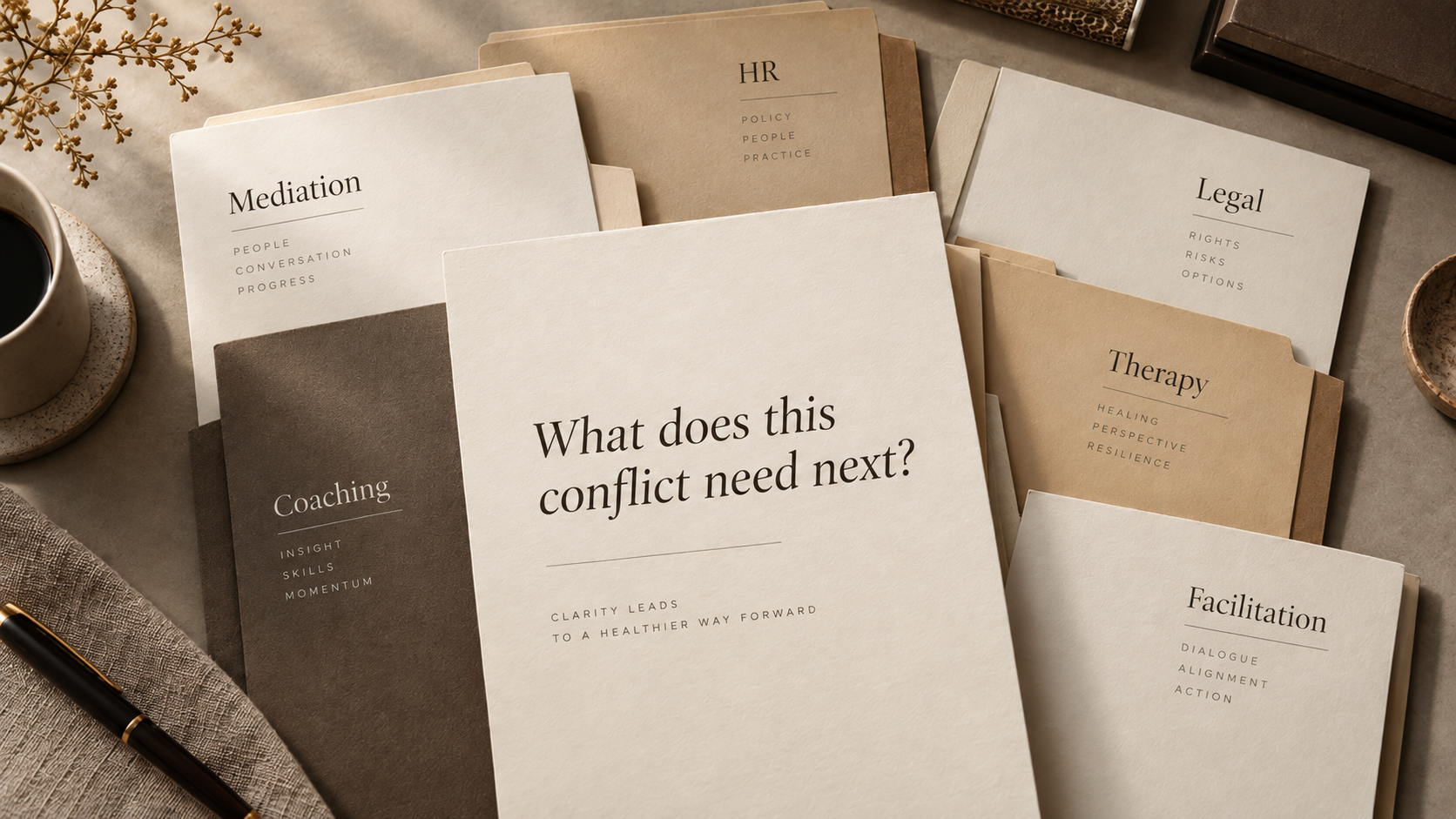
What Kind of Conflict Help Do I Need?
This article explains how to figure out what kind of conflict support fits a situation. It compares mediation, HR, legal advice, therapy, conflict coaching, facilitation, training, and conflict consulting, describing what each is designed to do and when it applies. Mediation suits people ready for a voluntary, structured conversation. HR addresses workplace policy and formal organizational issues. Legal advice covers rights and legal risk. Therapy addresses emotional and mental health needs. Conflict coaching prepares one person for a difficult conversation. Facilitation helps groups work through tension. Training builds skills for repeating patterns. Conflict consulting helps someone sort which option fits when they're not yet sure.
When conflict starts taking up too much space in your life or mind, it can be hard to know what kind of help to look for.
Do you need mediation? HR? Therapy? Legal advice? Coaching? Training? Or do you just need a clearer way to prepare for the next conversation?
A lot of people wait at this point. Not because they don't care, but because they're trying not to overreact. They don't want to choose the wrong professional, escalate too soon, or make the situation worse.
The problem is that waiting can make the conflict harder to address. And when you're already stressed, sorting through all the possible kinds of help can feel like one more decision you don't have the energy to make.
You may already know the situation needs attention, even if you don't yet know what kind of attention it needs.
The first question isn't always, "Who can fix this?" A more useful question is:
What does this conflict need next?
Sometimes the next step is a formal process. Sometimes it's legal advice, emotional support, mediation, or a facilitated group discussion. And sometimes the next step is simply getting clear before the conflict goes any further.
You don't have to diagnose the conflict perfectly before you ask for help. But it can be useful to understand the different kinds of support available, and what each one is designed to do.
A quick way to think about conflict support
These categories aren't always separate. A workplace conflict might involve emotional stress, unclear roles, possible policy issues, and a conversation that still needs to happen. A family or community conflict might involve hurt, history, safety concerns, and practical decisions all at once.
The goal isn't to label the conflict perfectly.
The goal is to identify the next step that can help move things forward.
Here's a simple starting point:
If the main need is
Safety, rights, legal risk, or legal consequences
You may need
Legal advice, advocacy, HR, or safety-specific support
If the main need is
A formal workplace concern, policy issue, investigation, or employment decision
You may need
HR or a formal organizational process
If the main need is
Emotional healing, trauma support, or mental health care
You may need
Therapy or counseling
If the main need is
A structured conversation between people who are ready to participate
You may need
Mediation or facilitation
If the main need is
Preparing for a hard conversation
You may need
Conflict coaching or conflict consulting
If the main need is
Sorting what to do before choosing a path
You may need
Conflict consulting
If the main need is
A repeating team, board, or workplace pattern
You may need
Training, facilitation, or organizational conflict support
If the main need is
Repairing trust, clarifying expectations, or deciding how to move forward
You may need
Mediation, facilitation, coaching, or consulting, depending on readiness
This kind of map can help, but real situations are often layered. You may need more than one kind of support over time. The important thing is to begin with the most responsible resource first.
Sometimes the question isn't only "What should this person do next?" but "What process, role, or expectation is missing here?"
Mediation may help when people are ready for a structured conversation
Mediation can be useful when two or more people need help having a structured conversation with a neutral third party. It can support people in talking through issues, clarifying interests, negotiating next steps, or reaching an agreement.
It can also help people address a conflict before it turns into something more formal, expensive, or adversarial. Court is costly, slow, stressful, and public in ways many people aren't prepared for. Mediation is often much less expensive than going through the court system, and when it's appropriate, it can help people resolve or narrow the issues before things get that far.
Mediation is often most useful when people are able to participate voluntarily, safely, and with enough capacity to engage in the process.
But mediation isn't always the first step.
It may not be the right starting place if there are immediate safety concerns, legal questions that need advice, an active investigation, a major power imbalance that hasn't been addressed, or if one or more people need preparation before sitting down together.
Sometimes the work before mediation matters. Someone may need to clarify what they want to say, understand their options, decide whether a joint conversation is wise, or identify what would make the process safe and useful.
Mediation is a valuable tool. It's not the only form of conflict support.
HR may help when the conflict involves workplace policy or organizational responsibility
In workplace settings, HR may be appropriate when the conflict involves policy, reporting, harassment, discrimination, discipline, performance, employment decisions, workplace safety, or formal organizational responsibility.
HR's role is different from a mediator, therapist, coach, or outside conflict consultant. HR is usually connected to the organization's responsibilities, policies, risk, compliance, and employment practices.
That can be exactly what's needed in some situations.
But not every workplace conflict begins as an HR issue. Some situations involve strained communication, unclear expectations, role confusion, leadership habits, team norms, or unspoken resentment before they rise to the level of a formal complaint or policy process.
In those cases, people may still need support. They may need to prepare for a conversation, clarify what belongs in a formal process and what doesn't, or decide whether the issue is becoming serious enough to involve HR.
Legal advice may help when rights, risk, or legal consequences are involved
Some conflicts include legal questions. These might involve contracts, custody, employment law, liability, restraining orders, property, discrimination claims, formal complaints, or other rights and obligations.
In those situations, legal advice may be important before making decisions, signing agreements, participating in a process, or taking action.
Conflict support isn't a substitute for legal advice. A mediator, coach, facilitator, or conflict consultant shouldn't tell you what your legal rights are or what legal strategy to pursue unless they're also acting in a qualified legal role.
If there may be legal consequences, it's wise to get the right legal guidance. Conflict support can sometimes work alongside that guidance, but it shouldn't replace it.
Therapy may help when the primary need is emotional or mental health support
Conflict can be deeply stressful. It can affect sleep, concentration, relationships, confidence, and a person's sense of safety or belonging.
Therapy or counseling may be the right primary support when someone needs emotional healing, trauma support, mental health care, relationship therapy, or help understanding personal patterns that are affecting their life.
This is different from mediation, facilitation, HR, legal advice, or conflict consulting.
There can be overlap because conflict always involves human emotion. But not every professional role is designed to provide clinical care. If the main need is emotional processing, trauma support, or mental health treatment, therapy may be the place to begin.
Conflict coaching may help when one person needs preparation
Sometimes people aren't ready for a joint conversation. They may still be sorting out what happened, what they want, what they're responsible for, what they can't control, or what they need to say next.
Conflict coaching can help one person prepare for a difficult conversation or decision. It may involve clarifying the issue, considering the other person's perspective, identifying goals, choosing language, anticipating challenges, and deciding how to stay grounded during the conversation.
This can be especially helpful when someone is tempted to avoid the issue, over-explain, escalate too quickly, or abandon their own clarity to keep the peace.
Coaching can also help someone sort what's theirs to own, what isn't theirs to manage, and where a clearer boundary may be needed.
Coaching doesn't require everyone in the conflict to participate. It can be a useful first step when the next move belongs to one person.
Facilitation may help when a group needs structure
Facilitation can be useful when a group needs help having a productive conversation, making a decision, clarifying expectations, or working through tension.
This might involve a team, board, committee, leadership group, community group, or workplace. The goal is often not to mediate a personal dispute, but to help the group communicate, participate, and move through a process more constructively.
Facilitation may be helpful when a group is stuck in circular conversation, avoiding the real issue, dominated by a few voices, unclear about decision-making, or struggling to surface disagreement in a useful way.
A facilitated conversation can create enough structure for people to participate more clearly and responsibly.
Training may help when the pattern keeps repeating
Sometimes the problem isn't one conversation. It's a repeating pattern.
A team may avoid conflict until resentment builds. Managers may be uncomfortable giving feedback. Board members may not know how to disagree productively. Staff may lack shared language for raising concerns. Leaders may wait too long because they mistake silence for alignment.
Sometimes repeated conflict is less about one difficult conversation and more about a missing agreement, unclear role, or pattern the group has learned to work around.
In those situations, a single mediation or coaching conversation may help, but it may not be enough.
Training can build shared skills, expectations, and language. It can help people understand how conflict escalates, how to prepare for hard conversations, how to listen under pressure, how to make clearer requests, and how to address tension earlier.
Training is often most useful when the goal is prevention, culture building, or capacity building, not just resolving one current dispute.
Conflict consulting may help when you're not sure what the situation needs
There's a space between handling conflict alone and escalating it formally.
That space matters.
Sometimes people need help sorting the situation before they know what process fits. They may need to understand whether mediation makes sense, whether HR should be involved, whether legal advice is needed, whether a group conversation needs facilitation, or whether the first step is simply preparing for a difficult conversation.
Conflict consulting can help with that discernment.
It may involve:
clarifying what's happening in the conflict
identifying what belongs to people, relationships, roles, systems, or formal processes
sorting possible next steps
preparing language for a hard conversation
deciding whether a joint conversation is appropriate
designing a process for a team, board, or workplace
recognizing when another kind of professional support is needed
This kind of support isn't about forcing resolution. It's about helping people make thoughtful, responsible decisions before the conflict becomes more damaging.
You don't need to rush to resolution.
Gaining clarity first is often the most responsible choice.
Why people wait too long
People don't only postpone or procrastinate because they lack information.
They delay because conflict is stressful. It can make people feel exposed, defensive, embarrassed, angry, afraid, or unsure of their own judgment. Leaders may worry that asking for help makes them look unskilled. Employees may worry that naming a problem will make things worse. Board members, colleagues, family members, or community partners may worry that bringing in support means the relationship has failed.
People also delay because they don't want to overreact.
People can minimize a conflict for too long, or assume the only options are "handle it myself" or "make it formal." Most situations have more choices than that.
They may think, "Maybe this isn't serious enough."
Or, "Maybe I should be able to handle this myself."
Or, "If I ask for help, does that mean I'm escalating it?"
But early support doesn't always mean escalation. It can be what prevents escalation.
Getting help can mean slowing down enough to tell the truth about what's happening, then choosing a next step that fits the actual need.
Questions to ask before choosing conflict support
If you're unsure what kind of help you need, these questions may help:
Is anyone unsafe?
Are there legal rights, policies, formal complaints, or employment decisions involved?
Do I need emotional or mental health support before I take action?
Is this situation ready for a direct or mediated conversation?
Do I need to prepare before engaging with the other person or group?
Is the issue mainly interpersonal, organizational, procedural, legal, emotional, or some combination?
Is this a one-time conflict, or is the same pattern repeating?
Is the goal repair, accountability, clarity, agreement, prevention, or a decision?
What would make the next step safer, clearer, and more useful?
You may not know the answers right away. That's part of why conflict can be difficult to navigate.
But even asking better questions can help you move from reaction to discernment.
You don't have to know the perfect category before asking for help
Not every conflict is ready for mediation. Not every conflict is an HR issue, a therapy issue, or a legal issue. Not every hard conversation requires a formal process.
But that doesn't mean you have to handle it alone.
There's useful support available before everything is formal, explosive, or hard to explain. Support might help you prepare, sort your options, clarify your language, understand what kind of process might fit, or decide who else needs to be involved.
The question isn't whether the conflict is "bad enough" to deserve attention.
The question is:
What does this conflict need next?
If you're unsure where to begin, a conflict consultation can help you sort what's happening, understand your options, and choose a thoughtful next step.

Why Gentle Feedback Can Still Start Conflict
The words were careful. The setting was private. The voice stayed calm. And the conversation still went sideways.
Gentle delivery helps. It doesn't erase the vulnerability of being evaluated. A look at the three layers underneath every feedback conversation, and why conflict afterward isn't proof that someone failed.
Feedback isn't received as neutral information. It passes through meaning, dignity, trust, power, and history.
The words were careful. The setting was private. The voice stayed calm. The feedback named a behavior instead of a person, and it may have opened with appreciation that was completely sincere.
And the conversation still went sideways.
The other person got quiet. Or defensive. Or tearful. Or abrupt. They heard criticism where care was intended.
I keep coming back to this pattern, because of how often people describe some version of it: I was gentle. Why did that still turn into conflict?
Most workplace advice treats feedback as a delivery problem. Be clear. Be kind. Be timely. Be specific. Stay open to dialogue.
All of that matters. It's also incomplete.
Feedback lands on a person who wants to feel competent, respected, safe, trusted, and valued. Even careful feedback can touch identity, dignity, belonging, fairness, power, and everything that has already happened between these two people.
Gentle delivery helps. It doesn't erase the vulnerability of being evaluated.
When feedback starts turning into conflict, it helps to look at three layers: the message being given, the meaning being made, and the conditions shaping how it lands.
Layer one: the message
Most people giving feedback think they're commenting on a specific behavior or outcome.
"The report needs more detail."
"That comment in the meeting landed as dismissive."
"I need you to check in earlier when a deadline is at risk."
To the giver, these are practical observations about quality, tone, or expectations. That kind of clarity matters. Many conflict practices start with the same discipline of separating what was observed from the evaluation added to it. Nonviolent Communication builds it into the first of its four parts.[2]
But a clear message isn't always received with that same narrow lens.
What the receiver hears might be: they think I'm not good at my job. They don't trust me. They think I'm difficult. My reputation is at risk. I'm not safe here.
Feedback may be about behavior. It often lands closer to identity.
That doesn't make the receiver unreasonable. It means the conversation has moved into human territory. Being asked to change can expose the gap between how we meant to show up and how someone else actually experienced us. That gap stings.
Layer two: the meaning
People don't only process what was said. They try to work out why it was said, why now, what it means, and what happens next. That sorting happens fast, often before the sentence is finished.
A manager says, "Your updates have been late the past few weeks."
The message is about updates. But the employee may already be building a story. They think I'm unreliable. They have no idea how much I'm carrying. They're blaming me for a system problem. They already made up their mind about me.
The feedback itself may be limited and reasonable. Once the receiver's mind starts filling in blanks, though, the conversation shifts from reflection to protection.
That's where conflict usually grows. In the space between the message and the meaning.
Sometimes the story is wrong. Sometimes it's partly right. Sometimes it's built from real history: earlier unfairness, inconsistency, being left out of things.
So the goal isn't to wave the reaction away as "just interpretation." Interpretations aren't always wrong. Tone, silence, timing, power, and repeated patterns carry real information, and people read them for good reason. The goal is to get more precise about what's actually known, what's being guessed at, and what needs clarifying before the conversation hardens into accusation and defense.
That precision matters because none of us reads behavior neutrally. Psychologists call it the fundamental attribution error: we overestimate how much someone's behavior comes from who they are, and underestimate how much comes from the situation they're currently standing in.[1] In feedback conversations it runs both directions. The giver believes a missed deadline is a character trait. The receiver takes the feedback as a verdict on who they are.
Layer three: the conditions
Sometimes the reaction isn't about the receiver's sensitivity or the giver's wording. Sometimes the conversation is more difficult because of the workplace it’s happening in.
Someone may react strongly because no one ever made the expectations clear. Because standards get applied inconsistently. Because they only hear from leadership when something's wrong. Because earlier concerns were ignored until they turned urgent. Or because the power difference makes the conversation higher stakes than the giver realizes.
An organization can say it values feedback and still leave people with no regular, low-stakes way to ask a question, check an expectation, or name a tension early. When those small openings don't exist, feedback arrives carrying everything that was never said. It becomes the moment the unspoken things finally surface.
Which is why a script does not help to build a feedback culture. A script helps with wording. It can't make up for unclear roles, inconsistent practice, or a workplace where people are expected to absorb correction without context.
Psychological safety is about this exact question: can people ask questions, give and receive feedback, raise concerns, and handle conflict without being punished for it?.[3] Without those conditions, even careful feedback feels like a verdict instead of a conversation.
Sometimes the feedback conversation is where the larger pattern finally becomes visible.
Defensiveness is usually protection
When feedback feels threatening, people don't answer from their most reflective self. They answer from protection.
That protection shows up as explaining, withdrawing, counterattacking, minimizing, blaming, going silent, or working very hard to prove they aren't the person the feedback seems to describe.
None of that excuses harmful behavior, and nobody has to accommodate defensiveness forever. But it explains why "I said it nicely" doesn't reliably produce a calm response. If feedback touches dignity, the body registers danger before the mind sorts through the details. The person isn't thinking, here's some useful information to consider. They're thinking, I need to protect myself.
It's an easy thing to hold against someone. It's also deeply human. We want to grow and we want to be seen as already worthy. We want honesty and we want some proof the relationship isn't being withdrawn.
Feedback asks something vulnerable of both people. The giver risks being disliked or misread. The receiver risks seeing an impact that doesn't match their intention.
That's why feedback isn't only a communication skill. It's a conflict skill.
Gentle isn't the same as clear
There's another reason careful feedback turns into conflict, and it's the less comfortable one.
Sometimes, trying to be kind, we get vague.
We soften until the message blurs. We wait too long because we don't want to hurt someone. We try so hard to soften the feedback that the person leaves unclear about what needs to change. We hint.
We say, "you might want to think about being a little more mindful in meetings," when we mean, "you interrupted two colleagues several times, and I need that to change."
Softening isn't the same as making something safe. Unclear kindness can create more threat, not less, because now the receiver has to guess. And people guess through anxiety. How serious is this? Are they more upset than they're letting on? Is there something else behind this?
Clarity isn't cruelty. Directness isn't automatically harsh. Often the most respectful thing available is to name the issue plainly while protecting the person's dignity.
The goal isn't feedback so soft it can't be used. It's feedback clear enough to understand and humane enough to stay in.
What belongs to the giver
None of this makes the giver responsible for managing someone else's feelings perfectly. That isn't possible, and chasing it isn't healthy.
The giver is responsible for their own part. Being clear about the behavior or the pattern. Choosing a respectful setting. Naming impact without going at character. Checking their own assumptions. Staying steady if the person gets emotional. Leaving room for questions or repair.
Beforehand, it helps to slow down and ask what exactly needs to be named, what this might imply to the other person about their competence or reputation or future, what context they need so they aren't left guessing, and whether this is landing as a surprise because it was never said before.
That preparation doesn't guarantee a smooth conversation. It prepares the giver for the whole conversation instead of just the opening line.
What belongs to the receiver
The receiver has work too.
Receiving feedback well doesn't mean feeling nothing, and it doesn't mean agreeing on the spot. It means making enough space between the feeling and the response to ask: what am I actually hearing, and what am I adding?
Out loud, that can sound like, "can you help me understand what you mean by that?" Or, "is this about this one situation, or are you seeing a pattern?" Or, "I'm noticing I feel defensive, and I want to understand before I respond." Or, "what would you need to see going forward?"
The receiver isn't responsible for the giver's comfort. They are responsible for not turning every uncomfortable message into an attack.
Compassion for how hard feedback is to receive shouldn't erase accountability. It should make accountability possible.
Naming the layer you're in
When feedback turns into conflict, people usually argue at one layer while reacting from another. The giver stays on the message: I'm just saying the deadline was missed. The receiver answers the meaning: you think I'm unreliable. The conditions press on both of them, through unclear priorities, an unrealistic workload, a history of information arriving late.
Unnamed, that gets confusing fast. Named, the conversation gets room.
The giver can say, "I want to be clear this is about the missed deadline, not a judgment about your commitment."
The receiver can say, "I think I heard that as you telling me I'm unreliable. Is that what you meant?"
A leader can ask, "is there something in our process that made this harder to catch earlier?"
None of that makes feedback painless. It makes it more accurate. And accuracy matters most right when conflict is forming.
Before the next one
Feedback isn't going to feel good. Growth, accountability, and repair usually ask for some discomfort. But discomfort doesn't have to turn into damage.
The question isn't how to give feedback so nobody ever gets defensive. A better one: how do I say the necessary thing with enough clarity, care, and steadiness that the conversation can survive the discomfort?
Three quieter questions help. What is the message? What meaning might this person hear? What conditions will shape how it lands?
Feedback goes better when both people can see that more is happening than one person delivering information. There's identity in the room. There's dignity, and power, and history. There may be a whole system in the room.
Once we can see that, conflict after feedback becomes less of a verdict and more of a clue: there may be confusion, fear, pride, unfairness, or unmet expectations underneath the reaction.
The work now is finding out what.
Sources
[1] APA Dictionary of Psychology, fundamental attribution error: https://dictionary.apa.org/fundamental-attribution-error
[2] PuddleDancer Press, The 4-Part Nonviolent Communication: https://nonviolentcommunication.com/learn-nonviolent-communication/4-part-nvc
[3] Center for Creative Leadership, How Leaders Can Build Psychological Safety at Work: https://www.ccl.org/articles/leading-effectively-articles/what-is-psychological-safety-at-work

What To Do When a Conversation Gets Tense
There's a moment in almost every difficult conversation when the tension becomes visible. Usually it's quiet. A pause that lasts too long, a question that lands harder than expected, someone who goes silent. This is a practical guide to what to do next: how to notice the shift, slow the pace without avoiding the issue, name tension lightly, separate what happened from what you assume it meant, and choose a next move that's honest and proportionate. Includes phrases you can actually use, common moves that make things worse, and a five-question check for the moment itself.
A practical guide to slowing the moment down without avoiding the issue
There's a moment in almost every difficult conversation when the tension becomes visible.
Sometimes it's obvious. Someone raises their voice, interrupts, shuts down, or says the thing everyone else was working hard not to say.
But usually it's quieter than that.
A pause lasts a little too long. A question lands with more force than expected. Someone's face changes. The pace picks up. A person who was participating goes silent. Your own body tightens before you've understood why.
These moments are one of the most important in any conflict and one of the easiest to mishandle.
Not because people are careless. Because they're human.
When tension rises, most of us want to do something fast. Explain. Defend. Smooth it over. Prove our intent. Make a joke. Push through. End the conversation. Get the other person to calm down.
But the first job in a tense moment isn't to solve the conflict.
It's to create enough steadiness for people to keep thinking.
That sounds small. It isn't. Many conflicts get worse because the conversation speeds up at the exact moment it needs to slow down.
Step 1: Notice the shift
Before deciding what to say, notice what changed.
Did someone's tone shift? Did the pace get faster? Did someone stop making eye contact? Did the conversation move from the issue to the person? Did you feel a sudden pull to defend yourself? Did the room get quiet in a way that felt loaded?
Tension gives information. It doesn't tell you exactly what's wrong, but it tells you something matters.
The mistake is deciding too quickly what it means.
A raised voice might mean anger. It might also mean fear, urgency, embarrassment, exhaustion, or someone trying very hard to be heard.
Silence might mean agreement. It might also mean overwhelm, resentment, caution, confusion, or the first step of withdrawal.
A sharp question might be a challenge. It might also be someone reaching for clarity about something that felt unfair.
Noticing the shift buys a little space before you react to the story your mind has already started building.
And sometimes the tension isn't only about this moment. It may be attached to something that's been building for a while: decisions made without input, feedback that went nowhere, uneven power in the room, a concern someone has raised before and watched disappear. Slowing down doesn't mean treating the moment as isolated. It gives you a better chance of seeing whether this is a misunderstanding, a pattern, or both.
Step 2: Slow the moment
Once you notice tension, the next move usually isn't a brilliant sentence. It's a slower pace.
A pause can be useful. A breath can be useful. A calmer tone can be useful. A simple sentence can be useful.
Before choosing words, it helps to do one physical thing that slows you down. Put both feet on the floor. Unclench your jaw. Take one slower breath. Let a little silence stay in the room. Small moves, but they keep your body from handing the conversation over to urgency.
This isn't about pretending to be unaffected, and it isn't about performing calm while something important is happening. It's about interrupting the automatic escalation that starts when everyone's nervous system begins driving.
You might say:
"Can we pause for a second? I want to make sure I'm understanding."
Or:
"I want to respond carefully, not react quickly."
Or simply:
"Give me a moment. I'm thinking."
Slowing down doesn't avoid the issue. Done well, it protects the issue from getting buried under defensiveness, accusation, or panic.
Step 3: Name the tension lightly
Sometimes it helps to name what's happening. The key is to name it lightly.
There's a difference between:
"This is becoming hostile."
and:
"I'm noticing this feels a little tense."
There's a difference between:
"You're getting defensive."
and:
"I think something shifted there. Can we slow down?"
The first version sounds like a diagnosis. The second creates a shared observation.
Naming tension lightly works because it brings the invisible thing into the room without making it bigger than it needs to be.
Some phrases that tend to help:
"I'm noticing this feels tense, and I don't want us to talk past each other."
"Something shifted there. Can we pause for a second?"
"I think we may have hit something important."
"I don't want to rush this part."
"Can we slow down and make sure we're talking about the same thing?"
The goal isn't to control the other person's reaction. It's to open a small space where both people get some choice back.
Lightly doesn't mean vaguely. You can name tension with kindness and still be direct about what needs attention.
Step 4: Separate what happened from what it means
This is where a lot of conflicts start to escalate.
Something happens, and almost instantly we make meaning from it.
Someone interrupts, and the story becomes, "They don't respect me." Someone doesn't respond, and the story becomes, "They're ignoring me." Someone asks a question, and the story becomes, "They're challenging my authority." Someone looks upset, and the story becomes, "I'm in trouble."
Sometimes those interpretations are right. Tone, timing, silence, power, and history all carry real meaning, and I don't think anyone should talk themselves out of what they noticed.
The point isn't to doubt your own experience. It's to get more precise.
What actually happened? What am I assuming it meant? What else could be true? What do I need to ask before I accuse?
Precision matters because people defend themselves against the accusation, not the observation.
"You interrupted me twice while I was explaining" is different from "You don't care what I think."
"I haven't heard back from you about this" is different from "You're avoiding responsibility."
"When the decision changed, I felt caught off guard" is different from "You went behind my back."
The meaning may still need to be discussed. But when a conversation opens with the most charged interpretation, it gets much harder for the other person to stay present for the rest of it.
Step 5: Choose the next right-sized move
Not every tense moment needs the same response.
Sometimes the next move is a question:
"Can you say more about what felt frustrating?"
Sometimes it's clarification:
"I want to separate what I meant from how it landed, because both matter."
Sometimes it's accountability:
"You're right. I interrupted you. Let me stop and hear the rest."
Sometimes it's a boundary:
"I want to keep talking about this, but I'm not willing to continue if we're insulting each other."
Sometimes it's a pause:
"I don't think we're in the best place to solve this right now. Can we come back to it with a little more space?"
If the issue is unclear, ask. If your impact is clear, repair it. If the conversation has turned disrespectful, set a boundary. If people are too activated to think, pause and return.
Right-sized move matters because people tend to reach for too much too fast. They try to resolve the whole relationship, defend their entire character, correct every misunderstanding, or force closure before the conversation is stable enough to hold it.
Your next move doesn't have to make the other person feel better. It has to be honest, proportionate, and inside your control.
In a tense moment, smaller is often stronger.
One clear question. One honest observation. One repair. One boundary. One pause.
Often that's enough to keep the conflict from growing larger than it needs to be.
What not to do when tension rises
A few moves reliably make things worse, even when the intention behind them is good.
Don't rush to reassure before you've understood the concern. "You're overthinking it" or "That's not what I meant" is usually an attempt to calm things down. It lands as dismissal.
Don't diagnose the other person. "You're triggered," "You're defensive," "You're taking this personally." There may be a piece of truth in it. There's also shame, and shame almost always brings more resistance.
Don't force resolution. Some conversations need space before they can be useful again.
Don't pretend nothing happened. When the tension is obvious and everyone silently agrees to ignore it, the conversation keeps going on the surface while the real issue moves underground.
Don't confuse intensity with danger. Some tension is uncomfortable because something honest is finally getting said. The goal isn't to eliminate discomfort. It's to keep discomfort from turning into harm.
A simple in-the-moment check
When a conversation gets tense, try asking yourself:
What changed?
What am I assuming it means?
What might the other person be experiencing?
What needs to slow down?
What's the next right-sized move?
You won't answer all five well in the moment. That isn't the point.
The point is to give yourself a way back to choice.
Conflict escalates when people lose the space between what they feel and what they do next. A simple check reopens that space.
The goal is steadiness, not perfection
Navigating tension well doesn't mean saying the perfect thing.
It doesn't mean staying endlessly calm, absorbing disrespect, avoiding directness, or making sure nobody feels uncomfortable.
It means noticing when the conversation is changing and deciding not to let reactivity make every choice from there.
Sometimes the most important thing you can do in a tense moment isn't solving the conflict.
It's slowing the moment enough that the next sentence has a better chance of being useful.
That's usually where repair starts. Not with a perfect script, but with a small return to steadiness, clarity, and choice.

Humboldt Is Small Enough That Conflict Follows You
In a small county, a disagreement can turn into a verdict about a person. That verdict is what travels, and it's waiting in the next room you both enter.
A few months ago, I saw a woman at the farmers market and turned the other way before I had time to decide.
Then my heart started going. I stood in front of a table of tomatoes I didn't want, bracing for her to come over and tell me again what kind of person I am for disagreeing with her. She didn't. I'm not sure she ever saw me. I bought nothing and left.
We fell out five or six years ago over a public figure neither of us had ever met and a controversy that had upset a lot of people. She'd been a friend. The disagreement got sharp, then personal, and she left. Later that night she texted me what kind of person I was.
Then came the part I didn't expect.
For most of a year, I checked parking lots for her car before I went into stores. I stopped going to a place I liked. I passed on volunteering with an organization I wanted to be part of because I knew she was involved and I didn't want to find out how that would go.
I told myself I was making choices. Mostly I was routing around one person.
I started going back to that place a couple of years later. I still go, rarely. It doesn't feel the way it used to.
Here's what I notice now, years out. I barely remember the argument. I remember the text.
That's the part of small-community conflict nobody warns you about. The disagreement didn't end. It changed rooms, and somewhere along the way it changed shape.
What a disagreement turns into
The argument ends and the conflict doesn't. It turns into hesitation. Side conversations. An invitation that doesn't come. A new calculation about who's safe to speak openly around. People stop calling it conflict. They call it awkwardness, or politics, or history, or just how things are.
It starts out being about a thing. A budget line, a hiring decision, a public figure neither of you knows. Then somewhere in the heat it converts into a claim about a person. What they're really like. What kind of person holds a position like that.
The conversion is fast, and it's almost always invisible to whoever is doing it. Once it happens, the original thing hardly matters. Nobody carries a budget disagreement around for five years.
People are rarely just one thing to each other
For many people in Humboldt, the person you disagreed with on Tuesday is also somebody's parent at the school event, or a colleague's partner, or already on the committee you're joining next month. That overlap changes what's actually at stake.
That's part of why people here can seem more guarded than the issue appears to call for. They're managing the next three conversations too.
Underneath that sits reputation, which in a small community becomes a silent participant in the conflict. People worry that one tense moment will turn into shorthand for who they are.
That's why someone can get defensive in a way that looks out of proportion from the outside. They're not just defending a position. They're defending their place in the story people tell about them.
Once people believe their character has been summed up unfairly, they usually stop listening for the issue underneath. The conflict stops being about what happened and becomes about who gets to decide what happened.
Avoidance isn't always cowardice
People stay quiet because they know they'll see the person again. Because the person is connected to a funder, or a school, or a client they can't afford to lose. They decide the issue isn't worth the social cost, and often they've done that math correctly. Avoidance is what a lot of people use to protect their ability to keep living, working, and belonging in the same place.
I still tell myself the volunteering worked out, and it did. I found other organizations. But it took me years to notice the difference between a decision and a detour.
The math isn't the same for everyone, either. An employee and a supervisor don't carry the same risk in the same disagreement. Neither do a tenant and a landlord, or a resident and the agency deciding on their permit. The person with less power is usually the one doing the swallowing. When they finally go quiet, it tends to get read as agreement.
Humboldt runs on a thin bench. The same people sit on boards, staff nonprofits, show up to hearings, run committees, and answer the phone when something needs doing. Every time one of them decides a room isn't worth entering, the pool gets smaller.
Do that enough times and the county's capacity to do things together shrinks. It shows up as a board that can't fill seats, a coalition that never quite forms, a good person who says no and doesn't say why.
The argument the other way
There's a version of this that runs the other way, and it's worth taking seriously. When people can't disappear, accountability can work better. Reputation can make people slower to burn someone, because they'll be standing next to that person at the co-op in a week. Both things are true. The same closeness that makes conflict hard to escape is what makes repair worth attempting.
Leaving a disagreement a disagreement
Repair doesn't mean pretending it didn't happen. It doesn't mean agreeing, trusting fully, or getting close again.
Mostly it means refusing to let the disagreement convert.
That's harder than it sounds, because converting feels good. Deciding what kind of person someone is settles the question. It also lets you stop taking them seriously.
But the verdict is the part that travels. A disagreement mostly stays where you had it. A verdict about someone's character goes on to the next conversation, and the one after that, and it arrives in rooms before either of you do. In a place this size, it will be waiting in a room you both have to walk into.
So the thing I try to hold now sounds smaller than it is. I can think you're wrong without deciding what you are. I can say so plainly. I don't need to make you smaller in order to make my point.
Not every relationship can or should be restored. Some conflicts reveal real harm, unsafe patterns, or a boundary that needs to hold. Repair isn't forced harmony, and it isn't the job of the person who got hurt.
But a lot of conflicts here aren't clean exits. They're relationships that continue whether anyone wants them to or not. In those, who was right is only half the question. The other half is what kind of contact we're building.
Dignity is what makes the next time possible
Dignity decides whether someone comes back.
People who feel humiliated, or permanently cast as the villain, stop showing up in good faith. They rarely fight about it. They just get quietly unavailable. People who feel challenged but not erased tend to stay. And staying is where accountability actually happens.
I don't know what would have happened if I'd turned around at the market. Probably nothing much. She may not have been thinking about me at all.
But I know what I was bracing for, and it wasn't an argument. It was hearing again what kind of person I am. That's what I'd spent a year routing around. Not her. The verdict.
We're going to keep running into each other here. In the aisle, on the committee, at the fundraiser, in front of the tomatoes. That part isn't up for negotiation.
So the question I keep landing on isn't how to make the point.
It's what I'm willing to leave intact on the way to making it.
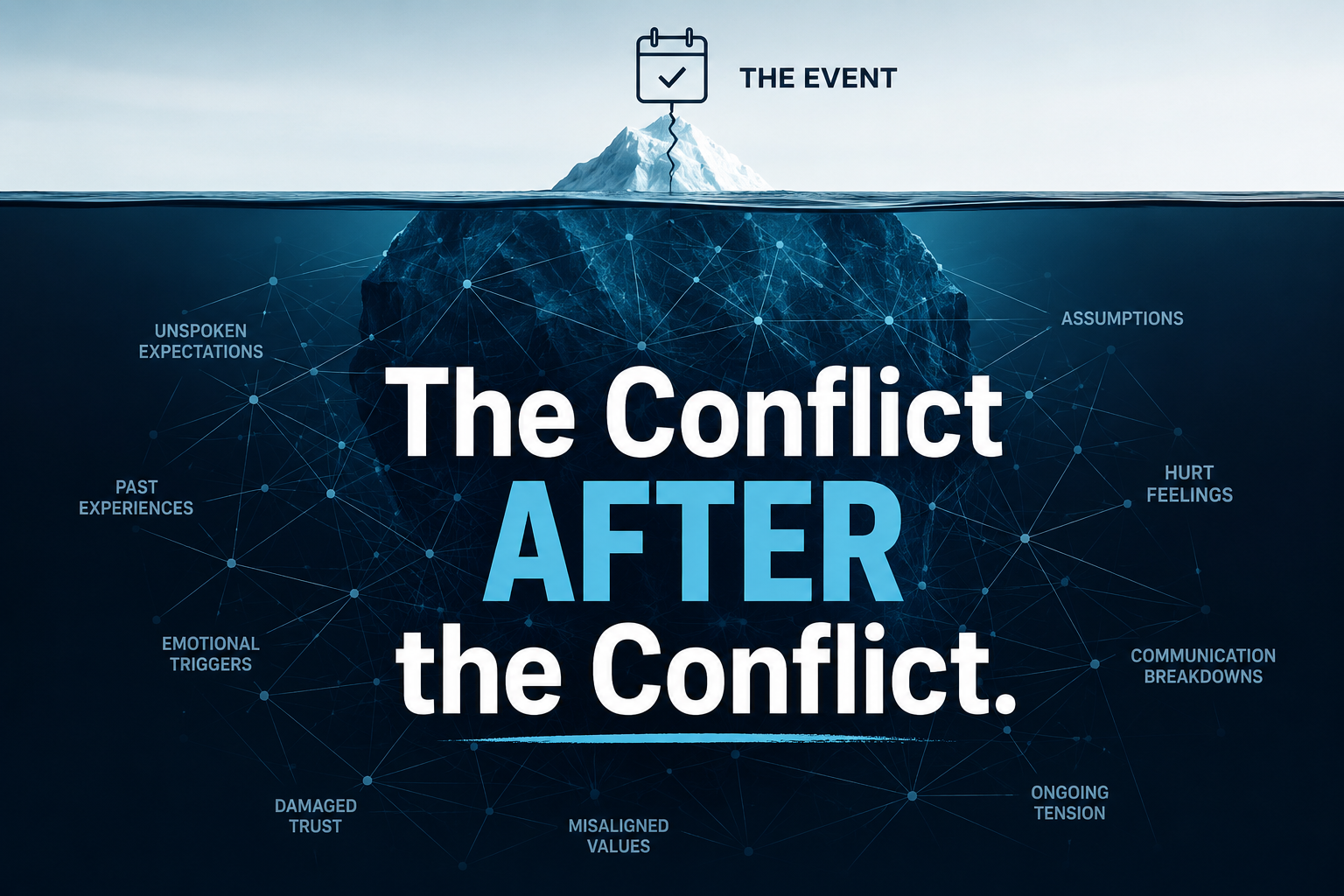
The Second Conflict Is Often the One That Lasts
The first conflict asks what happened. The second asks what it meant. In workplaces, families, and communities, the conflict around the conflict is often the one people are still living inside long after the original issue was declared handled.
Something happens. A decision gets made. A comment lands wrong. A mistake surfaces that someone hoped would stay hidden. And suddenly, someone walks away feeling dismissed, blamed, or left holding a weight they were never meant to carry alone.
That’s the first conflict. It’s tangible, obvious, and the one everyone points to. But that’s rarely the part that sticks.
What actually lingers is everything that grows up around it. Who defended whom. Who went quiet when it counted. Who got believed, who got dismissed, and who was quietly expected to just "get over it."
And underneath it all lies the question nobody asks out loud: What did everyone decide this whole thing meant about you? Your character. Your loyalty. Whether you can still be trusted.
That is the second conflict. And in a lot of workplaces, families, and communities, it’s the one people are still living inside long after the first one was declared "handled."
The conflict around the conflict
By the time a conflict is out in the open, people are rarely arguing about what actually happened anymore. They're arguing about what it meant.
A slow reply becomes proof of disrespect. Someone quiet in a meeting becomes someone who's checked out. A direct question becomes an attack. A short email becomes a verdict on who you are. A policy decision becomes evidence that leadership doesn't care, and a process update becomes evidence that somebody's being protected.
Before anyone has stopped to check anything, the event has already turned into a story.
And the story might be right. It might be pointing at something real: a pattern, a power dynamic, an old wound, a genuine breach of trust. But it is still an interpretation, and once it starts moving through a room, the conflict is no longer the same conflict. Now there's a second layer sitting on top of it.
What people made it mean. Who got pulled in. What quietly became unsafe to say. What everybody learned, watching how it played out, about who counts and who's just expected to absorb it.
That layer is usually harder to fix than the thing that started it. The first conflict asks what happened. The second asks what it meant. The second conflict runs on different questions. Who felt betrayed once the dust settled. Who felt cornered into picking a side. Who got the message that asking questions would cost them. Who got pushed to forgive before anything was actually repaired. Who quietly stopped trusting the room.
Those aren't footnotes. They're often the whole thing that's left once the official version of the conflict has been "addressed."
A manager thinks, we already had the meeting. A board thinks, we followed the process. A family thinks, everyone apologized. An organization thinks, the file's closed.
Meanwhile the people actually inside it are still reacting to everything that happened around the edges. The silence. The defensiveness. The private conversations everyone knew about and nobody named. The care that somehow reached some people and not others. The rush to move on.
Handled and repaired are not the same thing. Sometimes the first conflict really is over, and the second one is still quietly running the room.
What it looks like at work
Say someone raises a concern in a team meeting. Maybe it's about workload, or a decision that landed on the team, or expectations nobody ever made clear. That concern is the first conflict.
Then the second one starts, and it's quieter.
She notices who won't meet her eyes. The manager says "let's take this offline" and never circles back. A coworker who agreed with her in the hallway says nothing when it counts. Somebody starts calling her "negative." And leadership reframes the whole thing as a morale problem instead of an actual concern.
Now it isn't about the workload anymore. It's about whether saying something true changes how people see you. Whether keeping your head down is just safer. Whether this place can sit with a little discomfort without turning the person who named it into the problem.
That's usually why people stop speaking up. Not the original issue. What happened to the last person who did.
And in a community
It works the same way out in the open, just bigger.
Something kicks it off: an event, a decision, an allegation, a meeting that went sideways. And then the conflict around the conflict starts to swell. People get asked to decide who they believe before anyone knows enough to decide anything. Questions get read as disloyalty. Silence gets read as guilt. Public statements get combed not for what they say but for what they carefully don't.
Pretty soon everyone's reacting less to the original thing and more to what everyone else's reaction supposedly means. Who showed up. Who stayed home. Who defended the institution. Who defended the person who got hurt. Who came off as reasonable, and who got quietly filed under "difficult."
This is how a community gets swallowed by the second conflict. Not because the first one didn't matter, but because the meaning-making around it becomes its own kind of harm, its own fear, its own lasting mistrust.
So you can't understand a public conflict just by asking what happened. You have to ask what people are fighting about now, because of what happened.
Why it lasts
The second conflict lasts because it hooks into trust.
The first one is usually specific, almost small. A decision. A comment. A missed deadline. A bad interaction on a bad day. But the second one reaches something underneath all that. Can I actually be honest here. Will anyone believe me if I am. Am I going to pay for naming what I saw. Can this place tell the truth about itself, or does the process mostly exist to protect how things look.
Those questions don't go away because a meeting happened or a document got filed. They move into every conversation after. They decide who bothers speaking up next time and who doesn't. They color how people read the next decision, the next mistake, the next silence.
Which is why unresolved conflict looks so baffling from the outside. Somebody asks, why is everyone still upset, didn't we deal with this already? Maybe you dealt with the first conflict. Nobody touched the second one.
This isn't a way to wave off the original harm
One thing I want to be careful about.
Talking about the second conflict can quietly become a way to dodge the first one, and it shouldn't. Sometimes the original issue is serious. Sometimes real harm was done. Sometimes a process failed, or power got misused, or a person or an organization genuinely needs to own something.
The point isn't "everyone's just overreacting." The point is that the reaction becomes part of what needs care too.
If someone caused harm, repair has to deal with the harm. But it might also have to deal with whoever got left alone afterward. If a process failed, accountability has to name the failure. But it might also have to name what everybody learned from watching it fail. Naming the second conflict doesn't shrink the first one. It just explains why fixing the first one often isn't enough to account for what people are still carrying around.
How to find the second conflict
When a conflict feels way bigger than the thing that started it, it helps to pull the layers apart. A few questions I keep coming back to.
What was the first conflict, plainly? What actually happened, or broke, or got said.
What did people start making it mean? What did they decide it said about someone's character, or intent, or safety, or whether they belong?
Who got pulled in afterward? Who witnessed it, repeated it, defended someone, went silent, poured fuel on it, tried to smother it.
What quietly became unsafe to say? Which questions, or doubts, or plain anger started to feel too risky to put into words?
What did the process teach everybody? That truth and repair are possible here? Or that the safe move is to say nothing?
And then, what actually needs repair now? The first conflict, the second one, or both.
This matters because repair fails when you fix the wrong layer. If the original problem was a decision but the real wound is that people felt lied to, explaining the decision one more time won't touch it. If it was a comment but the wound is that everyone around it laughed or looked away, going after the one person who said it misses the room. If it was a mistake but the wound is that the organization scrambled to protect its own image, a corrected procedure isn't going to do it.
Repair has to reach both
Some conflicts need facts. Some need accountability, or an apology, or a clearer process, or somebody actually changing their behavior, or just time.
But once the second conflict has set in, repair also has to reach the meaning that grew up around the rupture. That doesn't mean everyone lands in the same place. It doesn't mean every read on the situation was fair. It doesn't even mean repair is fully possible in the shape people are hoping for.
It just means a conflict isn't finished the second the original event gets explained. People might still need to understand why they got left alone with the fallout. Why silence felt safer than honesty. What's actually going to be different next time. They might just need someone to say out loud that the conflict around the conflict did real damage too.
This is the part people want to skip, because it's messier and it asks more of everyone in the room. It's also where most of the real repair starts.
The one people are still living inside
The first conflict asks what happened. The second asks what happened after that. What people made it mean. Who got believed. Who got protected. Who went quiet. Who learned not to bother. Who's still paying for it.
If we only ever deal with the first one, we miss the part that's still shaping how people trust each other, and whether they feel like they belong.
Because the original conflict is often just the first rupture. The second one is where people are still living.
*Influences behind this piece include Marshall Rosenberg's work on observation and evaluation in Nonviolent Communication, Lee Ross's work on attribution, and the broader fields of conflict systems and restorative practice, especially the idea that process, repair, and community impact all belong in the same conversation.

When AI Enters a Difficult Conversation, Who Is Shaping the Process?
AI can draft the email. It can't tell you if the real problem is trust. A four-question test for using AI in hard conversations without losing the human part.
AI is getting easier to bring into the moments that are already hard.
A manager can ask it to draft feedback. A team member can ask it to soften a tense email. It can help someone practice what to say before a conversation they've been avoiding.
There's real use in that.
Difficult conversations are hard, not because people have nothing to say. It's because they're carrying too much: old history, fear, and the sense that one wrong sentence could make things worse.
So it makes sense people reach for a tool that offers calm and a little structure.
But the more AI shows up in mediation, HR, and everyday conflict at work, the more I think the real question isn't just whether it can help.
The deeper question is who's shaping the process.
Because in conflict, process is never neutral.
How you frame a problem shapes what people think the problem is. The questions you ask decide what becomes visible and what doesn't. A summary written after a meeting can turn into the only version of events anyone else gets. And the tone of your first message tells someone whether you're inviting them in, or just managing them.
That was true long before AI.
AI just makes the question harder to avoid.
The appeal of a tool is real
I don't think suspicion is the right place to start.
There are plenty of places AI can genuinely help with conflict. It can help someone organize their thoughts, or turn a defensive first draft into something calmer.
That kind of support can matter, especially for people who freeze under stress, or leaders who don't trust themselves to say things well.
None of that is careless. Some of it is genuinely useful.
The problem begins when the tool quietly moves from support to authority.
Someone asks AI to help them prepare, then quietly accepts its framing of what the conflict is even about. A manager asks for a summary, and that summary becomes the record everyone else works from.
The tool isn't making the final call. But it's already shaping the road to it.
Conflict support is not just language support
Part of the problem is that conflict often gets mistaken for a communication problem.
Sometimes it is. People do need clearer words, or a calmer way to open a hard conversation.
But hard conversations are rarely just about the words.
They're also about power, history, trust, timing, and how much each person stands to lose.
A better sentence can help.
It can't carry all of that.
Before you bring AI anywhere near a conflict, the question isn't just, can this tool make the message better?
The better question is: what kind of problem is this, really? Here's a fast way to sort it out, and what to do once you know.
Is this a writing problem? It just needs better tone or clearer wording. This is the safest place to use AI. Ask it to soften a reactive draft or tighten a message, then read the result out loud before you send it. If it still sounds like you on a good day, send it.
Is this a thinking problem? It needs help sorting facts from assumptions, or naming what people actually want. AI can help here too, but only as a sparring partner, not an oracle. Ask it for options or questions, then ask yourself what it missed. The gaps usually tell you more than the list does.
Is this a process problem? It needs clearer roles and steps everyone agrees on. AI can't design that for you. It doesn't know your organization's history or what's already been tried. Use it to draft an outline if that helps, but have someone who knows the terrain check it before anyone else sees it.
Is this a trust problem? It needs something no tool can give you: consent, repair, and a real person standing in the room. If you're not sure which problem you've got, ask yourself this: would a perfectly worded message actually fix it? If the answer is no, stop drafting and start showing up.
AI can help with the first two. It can support parts of the third. But when the real problem is trust, a tool just becomes a way to avoid the work only a person can do.
Before you open an AI tool near your next hard conversation, run it through those four questions. Most people can answer honestly in under a minute. The answer won't just tell you whether to use the tool. It'll tell you how much to trust what it hands back.
What AI cannot own
Some parts of conflict work you just can't hand off.
AI can't know if someone actually agreed to have it involved in something that affects them.
It doesn't know the history in the room, especially the parts no one ever wrote down. It can't tell the difference between a silence that means someone's thinking and a silence that means they've learned it isn't safe to speak.
It can't own the power in the room, decide what repair looks like, or look someone in the eye and say, “I'm responsible for this.”
That doesn't mean AI has no place here. It means the place has limits. Name them before you start, not after something goes wrong.
Before using AI, name the job
The simplest place to start is the four questions above.
Before you use AI for a hard conversation, name the problem first. Let that decide the job you give it.
If it's a writing or thinking problem, say so, and use the tool for exactly that. Draft. Summarize. Brainstorm.
If it's a process or trust problem, the same tool can still help around the edges. But don't let it evaluate, rank, or decide. That kind of involvement needs real consent, real review, and a real person willing to own what happens next.
There's a real difference between asking a tool to soften an email and asking it to tell you what someone's behavior means. And there's a difference between asking what questions might help you prepare, and letting the tool decide which ones matter.
The difference isn't always obvious in the moment. That's why you ask the four questions before things heat up, not during.
The question beneath the question
I don't think the future of AI in conflict work comes down to a simple yes or no.
The more useful question isn't, “Should AI be used?”
It's this: what kind of human responsibility has to stay visible when AI is used?
That means consent. Transparency. Checking the frame instead of swallowing the output whole. Knowing when a tool has quietly gone from helping to steering. And refusing to let efficiency stand in for care.
Most of all, it means remembering that conflict work isn't just moving information from one person to another.
It's about what people come to believe is possible between them.
A tool can help someone find the words, or slow down enough to ask a better question.
But it can't decide what trust requires.
It can't carry the weight of repair.
It can't replace the human work of building a process people can actually trust enough to enter.
So when AI enters a hard conversation, the question isn't only what it can do.
The question is who's shaping the process, who's accountable for it, and whether the people affected can still see enough of it to trust that a person hasn't quietly left the room.

The Kindness People Don't Expect
What World Cup visitors' surprise at American kindness reveals about conflict, trust, and why welcome works as evidence, not just niceness.
I have been surprised by how much joy I feel watching visitors from around the world experience the World Cup matches happening here in the US.
It is not only that they are having fun. Though I do love that part.
It is the videos of people filling streets, trying unfamiliar food, laughing with strangers, asking for directions, singing in crowds, reacting to grocery stores, tailgates, convenience stores, stadiums, and all the strange little details of being in a place that is not your own.
But the part that keeps catching me is how often people seem surprised by the kindness.
Surprised that strangers help them.
Surprised that people are friendly.
Surprised that someone will stop, explain, laugh, point them in the right direction, ask where they are from, welcome them, or make sure they are okay.
There is something very tender about that surprise.
Because people rarely enter a place empty-handed. They arrive carrying stories.
Some of those stories come from news. Some come from politics. Some come from television, social media, family warnings, reputation, stereotypes, or the general noise of a world that is very good at making people afraid of each other.
And then sometimes real life interrupts the story.
Not with a grand speech. Not with a perfect argument. Not with a carefully designed campaign to change anyone's mind.
Just with ordinary people being warmer than expected.
A stranger helping with directions.
A cashier making a joke.
A family explaining how something works.
A crowd making room.
A person saying, in one way or another, "You are welcome here."
That is the part that has been making me happy.
Not because America is uncomplicated. It is not. This same tournament has ICE agents stationed at stadiums, immigrant rights groups issuing formal travel warnings, and players and staff detained at the border before they ever reached a field. Not because kindness erases what is hard or painful or unjust here. It does not. Not because visitors were wrong to have concerns, questions, or assumptions. Most of us carry concerns, questions, and assumptions into unfamiliar places, and for some of the people in these videos, those concerns are not hypothetical.
But because there is something powerful about watching people encounter a version of a place that is more generous than the one they expected.
There is something hopeful about seeing a story soften in real time.
I think about this a lot in conflict work.
People do not enter hard conversations empty-handed either.
They arrive carrying a story about what kind of room they are walking into. They carry a story about what will happen if they speak honestly. They carry a story about whether anyone will listen, whether they will be blamed, whether the other person will be fair, whether the process is already stacked against them, whether the organization really wants to understand or only wants the problem to go away.
Sometimes those stories are based on real experience. Sometimes they are based on past harm. Sometimes they are based on patterns that have repeated for years. Sometimes they are based on fear, rumor, reputation, or one bad interaction that became the lens for everything after it.
Either way, the story comes into the room before the conversation does.
This is one reason I care so much about the conditions around conflict, not just the content of the conflict itself.
People often think the important part is the issue on the table. The decision. The complaint. The misunderstanding. The disagreement. The policy. The behavior. The thing everyone is supposed to talk about.
And of course that matters.
But people are also constantly asking quieter questions underneath the official conversation.
Am I safe enough to be honest here?
Will this person be fair?
Is anyone actually listening?
Will my words be used against me?
Is this process real, or has the decision already been made?
Do I belong in this room?
Those questions are not always spoken out loud. But they shape everything.
And often, they are answered less by what we claim and more by what people experience.
That is why welcome matters.
Not welcome as a vague niceness. Not welcome as pretending everything is fine. Not welcome as avoiding accountability or smoothing over real conflict.
Welcome as evidence.
Evidence that the room may be different than expected.
Evidence that the person across from you may not be only the role, label, or reputation you had assigned to them.
Evidence that something more human might be possible here.
This is easy to underestimate because the gestures can seem small.
A calm tone.
A clear explanation.
A chair set out before someone has to ask.
A facilitator making sure the person with less institutional power understands the process before the conversation begins.
A manager slowing down enough to say, "Before we decide what this means, let's make sure we understand what happened."
None of those gestures resolve the conflict by themselves.
But they can change what people believe is possible in the room.
They can lower the need to brace.
They can interrupt the assumption that no one cares, no one will listen, or the outcome is already decided.
They can give someone a reason to stay present long enough for a real conversation to happen.
That is not sentimental. It is practical.
When people expect hostility, they prepare for hostility. When they expect dismissal, they defend against dismissal. When they expect unfairness, they look for evidence that the process is unfair. And if the environment confirms what they feared, the story hardens.
But when the experience is different enough, something opens.
Not always. Not perfectly. Not immediately.
But sometimes.
Sometimes people revise the story.
I thought this place would be cold, but people helped me.
I thought I was walking into hostility, but there was steadiness.
I thought I already knew what kind of people they were, but then I met them.
That last one may be the most important.
So much conflict lives in the space between the person and the story about the person. Between the place and the story about the place. Between what happened and what we have come to believe it means.
Direct experience can complicate that.
It does not make every story false. Sometimes the story is accurate. Sometimes the harm is real. Sometimes the lack of trust is earned. Sometimes kindness arrives too late or too inconsistently to repair what has already been damaged.
But it is still worth noticing when experience gives people new information.
It is worth noticing when welcome becomes a kind of counter-evidence.
It is worth noticing when ordinary kindness gives someone a better story to carry home.
That is what I keep seeing in these World Cup moments.
People came for a game. They found celebration, noise, heat, food, confusion, crowds, and all the logistics of travel.
But many also seem to be finding something else.
They are finding that strangers can be kind.
They are finding that a place can be more generous than its reputation.
They are finding that people are often more complicated, more open, and more welcoming than the stories told about them from far away.
And I love that.
I love it because it is joyful.
I love it because it is human.
I love it because in a time when so many public stories are built around suspicion, contempt, and fear, there is something quietly beautiful about people being surprised by goodness.
Not perfect. Not uncomplicated. Just real, ordinary, human goodness.
The kind that helps someone find the train.
The kind that explains the menu.
The kind that makes a visitor laugh.
The kind that says, "We are glad you are here."
And maybe that is the question worth carrying beyond the World Cup.
What story are people carrying when they enter our workplaces, our communities, our classrooms, our meetings, our families, our public spaces?
What are they bracing for?
And what small experience of welcome might give them a reason to wonder if another story is possible?

Miranda’s Rescue, Humboldt County, and the Conflict the Legal Process Can’t Heal
The Miranda’s Rescue investigation has left Humboldt County grieving, angry, and divided. This post looks beyond the legal case to the community fracture underneath: the people who trusted, donated, defended, reported, and now feel betrayed, and why public comment and court proceedings alone cannot hold the work of repair.
Eight dogs. That's the number that broke Humboldt County's heart a month ago, when a sheriff's affidavit first alleged Shannon Miranda had killed and buried them on his rescue's property.
As of June 23, eight is not the number anymore.
That day, investigators brought heavy excavation equipment onto the 50-acre Miranda's Rescue property in Fortuna and started digging. The FBI and the USDA were there alongside the Humboldt County Sheriff's Office, executing a second search warrant. By the end of the first day, they'd recovered the remains of two more animals, a horse and a smaller animal whose identity hadn't yet been confirmed.
The numbers behind that excavation are what turn this from one property under suspicion into something much bigger. From the start of 2025 through May 1, 2026, investigators say Miranda's Rescue received more than 900 dogs from shelters across California and beyond. Investigators have confirmed 116 adoptions, and 71 dogs were still on the property when the first warrant was served in May. That leaves 731 animals unaccounted for.
No arrests have been made, and authorities have described the case as an active animal cruelty, fraud, and theft investigation. Sheriff Honsal has said investigators will turn the facts over to the Humboldt County District Attorney, the California Attorney General, and the U.S. Attorney's Office for potential charging decisions. Shannon Miranda has not been convicted of anything and is legally entitled to the presumption of innocence while that process plays out.
But long before any courtroom resolves what happened on that property, something else already has: this community has split in half.
Rose and her friends surrendered a dog named Marco to Miranda's Rescue in March. They'd spent two weeks caring for him, a stray Great Pyrenees, enormous and untrained but eager to please, after one of them found him in Eureka. One of them slept on the floor while he slept on top of her. They fell in love, but their apartments were not appropriate homes for Marco. They started a GoFundMe to cover the $500 surrender fee because they believed Miranda's 50-acre property would give Marco a real chance.
She was later told he'd been adopted by a woman in Oregon who wouldn't share her exact location and stopped sending photos.
When the Humboldt County Sheriff's Office executed the first search warrant at Miranda's Rescue in May, based on an affidavit in which a sheriff's detective alleged that owner Shannon Miranda had killed and buried at least eight dogs on his property, Rose found out. She still doesn't know if Marco is alive.
"I think I'm still kind of in denial," she said at a June 3 vigil outside the courthouse. "The idea that Marco's laying somewhere with a hole in his head, surrounded by dirt, is something that I haven't fully processed yet, but it’s definitely something I’m having a hard time handling."
That sentence describes where this community is right now. Processing something that hasn't fully landed. Holding grief and rage and uncertainty all at once. With nowhere to take any of it.
A community divided, predictably
Three weeks before federal investigators arrived with excavators, residents lined up at the June 2 Humboldt County Board of Supervisors meeting to speak during public comment. The split was visible almost immediately. Some residents described horror, urgency, and a demand for accountability. Others defended Miranda's character and warned against rushing to judgment.
It's easy to look at those responses and hear one side telling the truth and one side in denial. But that's not entirely what's happening here.
When a trusted community figure is accused of serious harm, communities don't just react. They fracture along relational lines. People who have known someone for years, who held bake sales for him, surrendered their most beloved animals to his care, trusted him with their money and their grief, aren't being naive when they defend him. They're being human. The mind protects what it has deeply invested in. That's not a character flaw. It's a feature of how trust works.
And the people demanding accountability aren't being a mob. They're also being human, responding to what the evidence in front of them is telling them, and to the pain of what they've lost.
Both responses are completely predictable. They will happen in every community that faces this kind of rupture. And no one is building a process for any of it.
The legal process will not heal this
Shannon Miranda has said, "A legal process is now underway to sort the facts from the lies, and I'm asking you to please hold fire until that process works its way through." That's a reasonable request for the legal question. Law enforcement, prosecutors, and, if charges are filed, the courts will determine what can be proven and what accountability looks like under the law.
But the legal process cannot heal a community.
Joe and Maurine spent years fundraising for Miranda's Rescue after adopting a dog from him. Their daughter and her friends held bake sales, donated everything they made. They don't know what happened to those dogs or that money. Even if the legal process eventually produces charges, findings, or a verdict, it won't give them that back.
Since the first stories broke, the circle of people carrying unanswered questions has widened. Shelters from Del Norte County to Napa to Palm Springs sent animals to Miranda's Rescue, believing they were giving them a better chance; Napa County alone sent 105 dogs. Many of those shelters are now trying to figure out how many of their own transfers are among the 731 animals investigators can't account for. That is not just evidence in a case. It is another layer of institutional trust that now has to be reckoned with.
Some shelters have begun trying to account for and retrieve the dogs they transferred. That matters. But it still leaves the larger community question unanswered: what happens to the people who trusted, donated, defended, suspected, reported, and now feel betrayed?
Speakers have described more than two decades of reports, missing animals, questioned practices, and unanswered concerns. That is not just an allegation against one person. It is a question a community has to sit with about itself: who raised concerns, who didn't listen, and what that means.
The legal process won't answer that question either.
Public comment is not conflict resolution
Here's what a community in crisis currently has access to: two minutes at a podium, in front of supervisors who cannot respond, on a topic that isn't even on the agenda.
Public comment is a release valve. It gives people somewhere to direct their voices when they feel unheard. That's not nothing. But it is not a process. There is no acknowledgment, no dialogue, no structured path toward any kind of shared understanding. People speak into a void.
Since then, the issue has also surfaced at the Planning Commission, where residents have questioned the county's decision to let Miranda's Rescue continue operating under a compliance agreement instead of suspending its permit outright. The rescue's permits were approved in 2003 and have been out of compliance with their original conditions for more than two decades. In early June, the county gave Miranda 14 days to sign and notarize a new compliance agreement tied to floodplain violations rather than pulling the permit. That, too, is not the same thing as a community process. It is a regulatory process, filtered through public comment, with residents trying to squeeze grief, anger, evidence, and institutional distrust into the margins of an agenda.
A woman at the vigil bought handcuffs specifically for Shannon Miranda and said she swallowed the key. Dan Martinez, who runs the San Jose-based rescue Adopt My Block, drove up after hearing that a dog named Oliver was back at Miranda's, and found him emaciated, with patches of missing fur and his spine visible through his coat. These are people in acute pain, responding to an absence of process with whatever they have available to them. That's what communities do when the formal structures fail to hold the weight of what's happening.
What could exist instead
I'm not suggesting the legal investigation, now involving the FBI and USDA on top of county and state authorities, should be interrupted or that conclusions should be drawn before evidence is heard. That's not what this is about.
What I'm saying is that the community fracture, the grief, the betrayal, the divided loyalties, the twenty years of unheard concerns, is its own wound. And it needs its own process.
Community dialogue circles. Restorative conversations facilitated by a neutral third party. A formal space, distinct from the courtroom, where people can bring what they're carrying and have it witnessed. Not to determine guilt. The legal process is for that. But to begin the slower, harder work of understanding how this happened, who was affected, and what accountability and healing might look like for a community that trusted deeply and is now in pieces.
Dan Martinez put it simply: "Crises precipitate change, and this is the crisis."
He's right. The question is whether this community will use it.
Sources
Humboldt County Sheriff's Office / County of Humboldt, "Miranda's Rescue Investigation," June 23, 2026
https://humboldtgov.org/m/newsflash/Home/Detail/6256
Lost Coast Outpost, "More Than 700 Dogs From Miranda's Rescue Remain Unaccounted For, Sheriff Honsal Says; Excavation of Grounds to Continue for Several Days," June 23, 2026
https://lostcoastoutpost.com/2026/jun/23/video-more-700-dogs-mirandas-rescue-remain-unaccou/
Lost Coast Outpost, "At Miranda's Rescue, Multiple Agencies, Including the FBI, Execute Search Warrant Authorizing Excavation," June 23, 2026
https://lostcoastoutpost.com/2026/jun/23/mirandas-rescue-investigation-update/
KRCR, "731 animals unaccounted for as investigators uncover remains at Miranda's Rescue," June 23, 2026
Lost Coast Outpost, "Miranda's Rescue Search Warrant Reveals Eight Dead Dogs Have Been Recovered; Sheriff's Investigator Believes Miranda Killed Them for Financial Gain," May 20, 2026
https://lostcoastoutpost.com/2026/may/20/mirandas-rescue-neighbor-says-she-caught-him-camer/
Lost Coast Outpost, "Protestors, Revulsed by Miranda's Rescue Allegations, Gathered En Masse Yesterday," June 3, 2026
https://lostcoastoutpost.com/2026/jun/3/protestors-revulsed-mirandas-rescue-allegations-ga/
Times-Standard, "Shelters in Napa, Berkeley retrieve dogs from Miranda's Rescue," June 4, 2026
Humboldt County Board of Supervisors meeting archive, June 2, 2026
The LEGO Conflict Is Not Just About LEGO
The Bricks & Minifigs LEGO dispute is not only a story about a missing collection. It shows how conflicts escalate when trust breaks, documentation is unclear, accountability feels uncertain, and people no longer believe the available process can resolve the harm. This analysis looks at the human, system, and meaning layers behind a public conflict and what leaders can learn before disputes expand beyond the original issue.
On its face, a dispute over a missing, mishandled, or poorly documented collection should not become a national conflict story. But the Bricks & Minifigs situation has many of the ingredients that cause conflict to expand beyond its original facts: a family who says they were harmed, a business defending itself, disputed records, a franchise structure, a valuable collection, public statements, lawsuits, creator coverage, threats, and thousands of people online trying to decide who to believe.
That is why the story has traveled so far.
Not because everyone suddenly cares about the resale value of LEGO Star Wars sets. Because the conflict is now carrying something larger: trust, accountability, process, power, and the question of what happens when people do not believe the available system is capable of resolving the harm.
I am not writing this to decide who is legally responsible. That belongs to the people directly involved, the evidence, and the courts. Public reporting and party statements still describe disputed facts: the value of the collection, the records available, who had authority, what was sold or paid, and who is responsible for repair. This article is not a verdict. It is a conflict analysis.
Because as a conflict story, this situation is worth paying attention to. It shows something that happens in many organizations, workplaces, communities, and public disputes:
The thing people are fighting about at the beginning is often not the only thing they are fighting about by the end.
The surface conflict is about property, records, and responsibility
At the center of the story is a valuable LEGO Star Wars collection that a family says was consigned to a Bricks & Minifigs store in the Salem/Keizer area of Oregon.
From there, the public story gets complicated quickly.
There are questions about the terms of the consignment, what inventory existed, what was sold, what was paid, what remained, and what records can prove it. There are questions about a change in store ownership, the role of former franchise operators, the role of corporate, and the responsibilities of later store owners.
Since the first wave of reporting, the legal and process layers have continued to evolve. Bricks & Minifigs has announced the permanent closure of the Salem, Oregon location, stated that it has parted ways with later franchise owners Brandon Best and Joshua Johnson, and said its investigation found significant evidence of negligence connected to the store transition and documentation.
Bricks & Minifigs has also filed suit against multiple people connected to the public campaign, while stating that it is prepared to discuss dropping claims against Bryan Mansell as part of a resolution. Those are party statements and reported developments, not neutral findings. But they matter because they show the dispute has moved from a missing-property question into a broader franchise, documentation, litigation, and accountability problem.
Reporting from Salem Business Journal describes conflicting sales records, disputed value estimates, point-of-sale data, lawsuits, and unresolved questions about what the family is actually owed and who is legally responsible for paying it. Bricks & Minifigs corporate has stated that the consignment arrangement was unauthorized and local to a former franchisee, and later valued the collection at roughly $95,000 to $100,000. While other creator and reporting analysis has suggested a different mix of missing inventory, unpaid proceeds, and disputed valuation. The exact number remains part of the conflict: people are not only arguing over what happened to the collection, but over what the loss is worth, what records should count, and who gets to define the harm.
Those questions matter. They are not small details.
In conflicts involving money, property, business ownership, or records, the facts are part of the harm. People need to know what happened, what can be proven, and who is credibly accountable for it.
But the public intensity around this story suggests that people are not only responding to the factual dispute.
They are responding to what they think the dispute means.
Once trust breaks, the conflict changes shape
When trust is intact, unclear information can sometimes be tolerated for a while. People may wait for clarification. They may give one another some benefit of the doubt. They may accept that a process takes time.
When trust breaks, the same uncertainty lands very differently.
A missing record does not feel like a missing record. It feels like concealment.
A delayed response does not feel like caution. It feels like avoidance.
A legal statement does not feel like risk management. It feels like a refusal to answer.
A disputed number does not feel like a normal accounting problem. It feels like someone is trying to shrink the harm.
This is one of the most important things to understand about conflict escalation. People do not only react to what happened. They react to what they believe the response reveals: Does this organization care? Is anyone taking responsibility? Are we being told the whole truth?
Those are not accounting questions. They are trust questions. And once a conflict moves into trust, the original issue becomes much harder to resolve on its own.
Even a correct spreadsheet may not repair what a poor process has broken.
The human layer: people are not abstractions in a public conflict
Public conflict flattens people quickly.
A family becomes a symbol of harm. A company becomes a symbol of greed or defensiveness. A franchise owner becomes either a villain or a scapegoat. A YouTuber becomes either a hero or an opportunist. Employees become representatives of a brand, even when they had no meaningful role in the original dispute.
That flattening is dangerous because it makes the conflict feel simpler than it is.
On the human level, this story includes people who may feel betrayed, accused, threatened, exposed, dismissed, or unsafe. It includes a family trying to understand what happened to something valuable. It includes local business owners whose reputations and livelihoods may be affected. It includes employees at unrelated locations who may suddenly be treated as responsible for a dispute they did not create. It includes people online who feel morally activated and want accountability.
Those responses are not all the same. They do not carry the same responsibility. But they are all part of the human field of the conflict now.
That is what happens when a dispute becomes public before people believe there has been a credible process for resolution. The conflict recruits more people. More emotion. More meaning. More harm.
The circle gets wider. And in a fast-moving public conflict, it may keep widening as new people, claims, and symbols attach themselves to the story.
The system layer: unclear process creates space for escalation
The system questions in this story are just as important as the human ones.
What documentation existed for the consignment? How was inventory tracked, and who had access to the records? What happens when a franchise location changes hands, and what does corporate need to know about local agreements? What is the escalation process when a customer, consignor, franchisee, or store owner says something has gone wrong?
These are not glamorous questions. They are operational questions. But operational gaps often become conflict accelerants.
Documentation can feel bureaucratic until trust breaks. Then everyone wishes the record had been clearer.
A signed agreement, an inventory process, a transaction log, a change-of-ownership checklist, and a clear escalation pathway are not just administrative safeguards. They are conflict prevention tools. They help people avoid having to reconstruct reality after the relationship has already deteriorated.
In this story, the public appears to be watching multiple versions of reality compete at once. Different parties point to different facts, timelines, records, and responsibilities. That does not automatically tell us who is right. But it does tell us something about process.
When the process is not trusted, people look for another one, litigation, media attention, social media, public pressure, or all of them at once.
The meaning layer: people are fighting over what the story proves
The deepest conflicts are rarely only about what happened. They are about what the event seems to prove.
In difficult conversations, people are rarely having only one conversation. They are talking about what happened, yes, but also about respect, identity, safety, fairness, and whether the other side can be trusted. The Harvard Negotiation Project’s Difficult Conversations framework is useful here because it treats hard conversations as layered: there is the “what happened” conversation, the feelings conversation, and the identity conversation.
Public conflicts work similarly, except the layers become visible to everyone.
To some observers, this story seems to prove that a family was ignored until the internet paid attention. To others, it seems to prove that online audiences can destroy reputations before facts are fully known. To some, it is a story about corporate accountability; to others, about local franchise failures. To some, it is about consumer protection; to others, about harassment and the monetization of conflict.
That is why the conversation becomes so charged. People are not only debating a collection. They are debating which larger story this belongs to. And the answer may not be only one of those things. That is exactly why the conflict is so difficult to hold.
High-conflict public stories often become battlegrounds for bigger questions people already care about: power, fairness, trust, exploitation, responsibility, safety, and whose version of events gets believed. Once those questions enter the room, the original dispute is no longer carrying only its own weight.
Public pressure can reveal harm. It can also create new harm.
One of the hardest things about this story is that two things can be true at the same time.
Public pressure can surface a concern that people believe was ignored. And public pressure can create new harm when it stops distinguishing between responsibility, proximity, and association.
That distinction matters. Accountability requires precision. It asks: Who had authority? Who had knowledge? Who had responsibility? Who benefited? Who failed to act? Who can repair what happened?
Escalation often loses that precision. It asks: Who is connected to this? Who can be pressured? Who can be made visible? Who can be punished quickly enough to satisfy the public demand for action?
Those are very different questions.
Public attention is not inherently wrong. In some cases, it is the only reason an ignored concern becomes visible. But when attention becomes pressure, and pressure becomes targeting, people can be harmed based on proximity rather than responsibility.
Recent reporting has also described disputes over fundraising, speech restrictions, and online creator activity, including Bricks & Minifigs denying that it attempted to seize the Mansell family GoFundMe. Whether or not each claim proves accurate, the pattern is familiar: once the conflict moves online, the process itself becomes another thing people fight over.
When a conflict is moving fast online, the difference between accountability and punishment can collapse. People may start with a legitimate demand for answers and end up targeting people who cannot answer them. They may seek accountability and create fear. They may demand repair while making repair harder.
None of that means the underlying grievance should be dismissed. It means accountability needs structure. A credible process, not just public pressure. Otherwise, the conflict can grow so large that even the original harmed party is no longer fully at the center of it.
Legal resolution and trust repair are not the same thing
The legal process may eventually clarify some of the factual and financial questions in this case. It may determine responsibility, assign liability, validate some claims, and reject others. That matters.
But legal resolution and trust repair are not the same thing.
A court can decide a claim. It cannot automatically restore public trust. A settlement can resolve a financial obligation. It cannot automatically answer why people felt they had to go public to be heard. A corporate statement can correct a narrative. It cannot automatically make people feel that the process was trustworthy from the beginning.
This is where many organizations misunderstand conflict. They assume that if the legal question is being handled, the conflict is being handled. But the legal question is only one layer. The trust question, the process question, and the meaning question still have to be addressed — and if they are ignored, people may experience the formal resolution as incomplete, even if it is technically accurate.
The broader lesson for leaders and organizations
Most organizations will never face a viral LEGO controversy. But many will face some version of this pattern: a concern is raised, the documentation is messier than it should be, the person raising it does not feel heard, and the organization responds cautiously, defensively, or too slowly. People begin filling in the gaps with their own interpretations. The conflict moves from the original issue into trust, identity, fairness, and accountability.
By the time leaders realize the conflict has changed shape, they are no longer only trying to solve the first problem. They are trying to repair the damage created by how the first problem was handled. This is not only a communications problem. It is a process problem. It is a leadership problem. It is a trust problem.
Research on workplace conflict points in a similar direction: conflict is not handled well by good intentions alone. It requires early attention, manager capability, sensitive process, and enough psychological safety for people to raise concerns before they explode. CIPD’s research on managing workplace conflict is a useful reminder that people managers can either help resolve conflict or unintentionally make it worse.
Before a conflict becomes public, leaders can ask:
• What do we know, what do we not know, and what are we still verifying?
• Who has authority to respond, and who has been harmed, affected, or pulled into the conflict?
• What documentation would a reasonable outsider expect us to have?
• What can we communicate now without pretending to know more than we do?
• What process exists for appeal, review, escalation, or repair?
• Who needs protection from retaliation, harassment, or misdirected blame?
Those questions do not guarantee a perfect outcome. But they create a better container for the conflict before the public creates one for you.
That is the lesson worth carrying from this story. Not that every public accusation is true. Not that every corporate defense is false. Not that every viral campaign is justice. Not that every legal response is avoidance.
The lesson is that conflicts expand when people do not trust the process available to them. If leaders want to prevent that expansion, they need more than good intentions. They need clear records, credible escalation pathways, timely communication, and enough humility to recognize when a conflict is no longer just about the thing that started it.
Because by then, people may be fighting about something much larger: whether they were heard, whether the process was fair, whether the organization can be trusted, what the event proves. And once that happens, resolving the original issue is necessary. But it is no longer enough.
A question worth asking earlier
When a conflict escalates, it is tempting to keep asking, “What happened?” That question matters. It should not be skipped. But it is not the only question.
At some point, especially when the conflict has grown, it is also worth asking: What are people fighting about now that they were not fighting about at the beginning?
That question does not replace accountability. It makes accountability more precise. It helps separate the event from the response, the facts from the meaning, the original harm from the additional harm created by escalation. And sometimes, it reveals the real work ahead.
Because the LEGO conflict is not just about LEGO. It is about what happens when trust breaks, the process is not enough, and everyone starts building their own version of the story.

Why “Just Talk to Them” Is Incomplete Conflict Advice
"Just talk to them" sounds practical — but it often makes conflict worse. Learn what effective conflict conversations actually require: structure, timing, and safety.
Hard conversations do not only require courage. They require structure, timing, neutrality, and enough safety for people to actually tell the truth.
An employee tells a manager that a teammate keeps dismissing their input in meetings. A board member says a conversation with the chair no longer feels safe. A volunteer admits they are avoiding someone because the last attempt to talk only made things worse.
In each situation, someone nearby may offer the same advice:
“Just talk to them.”
It is one of the most common pieces of advice people receive when they are dealing with conflict at work, in a community group, in a family system, or inside an organization.
On the surface, it sounds reasonable. Direct communication is often better than avoidance. Many misunderstandings do need a conversation. And yes, sometimes people do need to stop venting and speak to the person involved.
But “just talk to them” is also incomplete advice.
Sometimes it is even bad advice.
Because conflict is rarely solved by conversation alone. It is solved by the right kind of conversation, at the right time, with the right structure, and with enough safety for people to participate honestly.
This matters especially for people in leadership or support roles, because the advice they give can either create a path toward repair or quietly send someone back into a situation they do not have the power to change.
Why “Just Talk to Them” Can Make Conflict Worse
Without those conditions, “just talk to them” can make things worse.
When someone is struggling with conflict, they are often not avoiding the conversation because they do not know talking is an option.
They are avoiding it because something about the conversation feels risky.
They may not trust the other person to listen. They may have tried before and been dismissed. They may be dealing with someone who interrupts, denies, blames, or redirects. They may worry that honesty will damage the relationship permanently.
In those situations, telling someone to “just talk to them” can sound practical, but it actually skips over the most important question:
What would make that conversation safe enough, clear enough, and useful enough to be worth having?
A person can be willing to talk and still not be ready. A team can schedule a meeting and still not have the structure to use it well. But recognizing that gap is the advisor’s job, not the conflict participant’s. When someone comes to you with a conflict, the question is not just “have they talked to each other yet?” It is: what conditions would make that conversation worth having?
Conflict Conversations Need a Container
This is why so many conflict conversations fail. Not because people never talk, but because they talk without a container.
They talk too soon, or when one person is overwhelmed or defensive. They talk without agreeing on what the conversation is for. They talk when one person has much more power and the other knows there may be consequences. They talk after months of buildup and expect one meeting to repair everything.
Conversation matters. But conversation without structure often becomes another round of the same conflict.
Before encouraging someone to “just talk to them,” it is worth asking what kind of support the situation requires.
Most conflict conversations need at least four things: structure, neutrality, timing, and psychological safety.
Structure
Structure means the conversation has a purpose, boundaries, and a process.
Without structure, people often default to their usual conflict patterns. One person over-explains. Another shuts down. The conversation becomes circular, emotional, or vague.
A structured conversation answers questions like: What are we here to discuss, and what are we not trying to solve today? Are we trying to understand, make a decision, repair harm, or create a plan? What happens after the conversation?
A simple structure might look like this: each person shares what happened from their perspective, names the impact, and identifies what they need going forward. Together, they clarify agreements, next steps, or unresolved issues.
That is very different from “just talk.”
Neutrality
Some conflicts need a neutral third party, especially when trust is low, power is uneven, or the same conversation keeps happening without progress.
Neutrality does not mean the third party has no values or never intervenes. It means they are not there to win the argument for either side. Their role is to protect the process, slow down reactivity, and help people stay engaged long enough to understand each other.
In workplaces, this might be a mediator, ombuds, trained facilitator, or outside consultant. In community or family conflict, it might be a restorative practitioner, counselor, or someone both parties genuinely trust.
Neutral support roles, such as organizational ombuds, are grounded in principles like independence, impartiality, confidentiality, and informality, all of which protect the process rather than choose a side.
Timing
Timing can make or break a conflict conversation.
People are often encouraged to address conflict quickly, and that can be helpful. But “quickly” is not the same as “immediately.” A conversation is unlikely to go well when someone is overstimulated, cornered, exhausted, or still actively trying to understand what happened.
Good timing asks: Has each person had enough time to regulate? Is this the right setting? Are we catching someone off guard before a deadline, performance review, or public meeting?
Sometimes the most responsible move is not to talk immediately. It is to pause, prepare, and choose the right moment.
That pause is not avoidance. It can be conflict wisdom.
Psychological Safety
Psychological safety means people believe they can speak honestly without being punished, humiliated, dismissed, or retaliated against.
Google’s Project Aristotle research describes psychological safety as people’s perception of the consequences of taking an interpersonal risk, whether they can speak up, ask a question, or offer a different view without being embarrassed or punished.
A manager may say, “I want honest feedback,” but an employee may know that honesty has not gone well for others. A board chair may welcome all perspectives while members have learned that disagreement leads to exclusion. When safety is missing, people may attend the conversation and appear cooperative. But they will not say what needs to be said.
They will edit themselves. They will perform agreement. And leaders may mistakenly conclude the conflict has been resolved, when really it has gone underground.
Another problem with this advice is that it places responsibility on the person already experiencing harm, and lets the organization or leader off the hook. When someone brings a concern forward and is told “just talk to them,” the message they often receive is: you manage this.
That may be unfair if the person has less power, less protection, or less emotional bandwidth. Before recommending direct conversation, leaders should ask:
Is this person being asked to carry a conflict the system should be addressing?
Has the other person shown capacity to engage respectfully?
Is there a power imbalance? Has this already been tried?
What support would make the conversation fairer?
If those questions are skipped, “just talk to them” can become a form of abandonment disguised as empowerment.
CIPD’s research on workplace conflict notes that people managers can be just as likely to exacerbate a conflict situation as resolve it, which is why early support, process, and structure matter.
When Direct Conversation Is Not the Right Next Step
It is also worth naming what direct conversation cannot do. If the situation involves harassment, discrimination, retaliation, abuse, threats, or formal policy violations, the responsible path may include documentation, HR, legal guidance, or safeguarding procedures. As an advisor or leader, recommending direct conversation in those situations can inadvertently bypass accountability structures that exist for good reason.
Many conflicts can be addressed through ordinary conversation, especially when trust is intact and the stakes are low. But even informal conversations benefit from a better container.
Better Questions to Ask Instead
Instead of saying, “Just talk to them,” try:
“Would it help to plan what you want to say first?”
“What outcome are you hoping for?”
“Do you feel safe having that conversation directly?”
“Is now the right time, or do you need to prepare?”
“What would make the conversation productive instead of circular?”
These questions change the advice from simplistic to supportive. They recognize that conflict is not just about getting people in the same room. It is about creating conditions where something different can happen in that room.
The better response is often not to solve the conflict immediately. It is to help assess what kind of conversation the situation requires.
“Let’s think about what kind of conversation this requires.”
“Do you want to be heard, make a request, set a boundary, repair the relationship, or document a concern?”
“Is this a conversation you can have directly, or does it need support?”
“What has happened in past conversations with this person?”
“Would it be useful to have someone facilitate?”
These responses do not discourage direct communication. They make direct communication more responsible.
The goal of a conflict conversation is not to check the box that communication happened.
The goal is movement: toward clarity, toward accountability, toward repair, toward a decision, toward a safer or more functional working relationship.
If a conversation does not create movement, it may simply repeat the harm in a new setting.
That is why “just talk to them” is not enough.
People do need conversation. But they also need preparation, process, and support. They need to know whether the conversation is safe, whether the purpose is clear, and whether there is a path forward afterward.
Conflict is not resolved by words alone.
It is resolved when the conversation is held in a way that makes honesty, accountability, and change possible.
If the people in your organization, your board, your team, or your community keep having the same conversations without real movement, the problem may not be willingness. It may be that the conversation needs a better container.
A facilitated conflict process can help people move beyond venting, avoidance, and circular discussion toward clearer agreements, better understanding, and more durable repair.
If someone in your organization is being told to "just talk to them," but the situation already feels loaded, unclear, or risky, a little structure can help. You do not have to figure out the whole conflict before reaching out. Share the high-level shape of what is happening, and I will help you identify the kind of support that fits.
Sources
International Ombuds Association, Standards of Practice & Code of Ethics
Google re:Work, Understand team effectiveness

The AI Output Was Approved. The Trust Wasn't.
AI can get the output right and still break trust. Here's why the accountability gap matters more than the technology — and what leaders need to do about it.
A few weeks ago, reporting from TechCrunch and 404 Media said arXiv would begin banning researchers for a year if they submitted papers where it was obvious no human had looked at what the AI produced. Things like hallucinated citations, notes the LLM left in the text, placeholders where real data was supposed to go but never did.
arXiv's own moderation policy is clear about this. If you put your name on it, you own it, no matter how it was generated. According to the reporting, get caught submitting something with obvious signs of that and you are out for a year, and after that your work may have to pass through a reputable peer-reviewed venue before arXiv will look at it again.
These are the easy failures to spot. The harder problem is what happens when the output looks fine. arXiv is talking about research integrity, yes. But the problem is bigger than research. AI-generated work is moving into official channels, going out under the organization's name, and too often no one has clearly owned the work of verifying it. When it fails, the accountability question gets passed around like something no one wants to hold.
That pattern is not going to resolve itself at the technical level.
You deployed the tool. The team was excited. The vendor demo was clean, the use case was obvious, the productivity gains were real. Six months in, you can see the hours saved on the dashboard. But you can also see something you were not expecting. Complaints have ticked up. The people doing the work seem more guarded than before. Customers, patients, employees, donors, community members. They are quietly losing trust in processes that on paper are working better than ever.
Nobody quite knows how to explain it. The AI is doing what it was asked to do. The output is technically correct. The recommendation, message, or decision is defensible. And yet somewhere downstream, a person reads what the system produced or sits with what it decided, and something in them goes still.
The email is correct and lands wrong. The denial is technically defensible and breaks something. The summary captures what was said and misses what was meant.
The system performed the task. It did not understand what the task meant.
Meaning is not the same as accuracy. Meaning is what the action communicates to the person on the other end of it. What context it lands in. What power it activates. Whether the person feels seen or just processed. The patient does not appeal. They just stop trusting the portal. The employee does not file a complaint. They stop being candid in the next survey. The customer does not explain what broke. They just stop believing the organization understands them.
Most leaders reach for the wrong diagnosis when this happens. We assume the AI needs a better prompt, a larger training set, a more sophisticated model. We treat the gap as a capability problem.
It is not. Or at least, it is not only that. The deeper problem is not just whether the tool can complete the task. It is whether the organization has decided who is responsible for the human consequences of that task once it reaches another person.
The arXiv case makes something visible that has been building quietly everywhere else. When a researcher submits a paper with fabricated citations they never checked, the issue is not only whether they intended to deceive. The issue is that they put the organization's credibility behind work they had not verified. Who is responsible? arXiv's answer is clear: the researcher. Full stop.
That clarity is notable because most organizations do not have it. When an AI system produces an output that breaks trust, the accountability question tends to float. Was it the tool? The prompt? The person who approved deployment? The vendor? The leader who set the efficiency target? In the absence of that clarity, organizations default to the path that protects everyone in the room, which usually means the person on the receiving end absorbs the cost quietly.
This is the structural problem. The AI missed what the action meant, and no human had been clearly assigned to check that part.
Technical problems have owners: vendors, IT teams, implementation leads. Accountability for how a message lands is harder to assign because it implicates leadership, culture, incentives, and the promises an organization has made to the people it serves.
In a recent essay on the next phase of AI, Nate B. Jones calls this access without meaning. His argument is that AI tools are getting impressively good at doing tasks. They open browsers, draft emails, schedule meetings, process claims, complete workflows. But they still do not understand what the task means inside a relationship, an institution, or a person's life. The action is performed. The significance is missed.
His central line is the cleanest articulation of this I have found: Computer use gives agents reach. Semantic control gives them judgment.
Giving a system access to act is not the same as giving it the judgment to understand what its action will mean.
Reach is what the demos sell. Judgment is what organizations actually need. Reach lets a system act. Judgment lets it know whether the action is wise, whether the timing is right, whether what is technically defensible is also relationally sound.
arXiv researchers are not the only ones submitting outputs they never fully read. They are just the ones who now have a formal policy naming what that costs.
Most leaders reach for one of two responses. The first is technical optimism. Better prompts, better models, better data. The second is avoidance. Pull back, wait, let someone else figure out the ethics. Both miss the point. Stop treating this gap as a bug. It is part of the work now, and it belongs to the organization to govern.
There is a third response, and it is the one almost no one is set up to take seriously yet.
Treat the gap as territory, not as a defect.
This is not a missing feature in the software. It is where dignity lives. Where trust is built or quietly broken. Where institutions earn the right to operate, or slowly stop earning it. None of that is a software category. None of it can be retrofitted in a future release. It belongs to the part of organizational life that has always required human attention.
This is the territory conflict practitioners have always worked in.
The work itself does not look like much, which is part of why it is so easy to underestimate. It looks like sitting with the manager whose team has stopped speaking honestly in meetings and asking the question no one else has asked. It looks like noticing that a denial letter, however legally sound, communicated something the organization did not intend. It looks like helping a leader see that what the dashboard calls efficiency may also be wearing down the trust their staff used to offer without thinking.
It looks like the quiet, often unmeasured work of restoring a connection between a system and the people who must continue to live and work inside it.
This is not a soft skill set, and it is not a temporary one. It is the practice of paying attention to what an action communicates after it has been completed. To the second-order effects automation cannot yet see. To the moment a customer, patient, or employee silently decides to stop fully engaging. Some of this eventually shows up in metrics: complaints, appeals, churn, disengagement. But by the time it does, the trust loss has often already begun.
Nate B. Jones frames this as an engineering frontier. I understand why. But for conflict practitioners, this is not new terrain. It is the work we have always been doing. Paying attention to what a decision communicates after the decision has technically been made.
Before deploying AI into any consequential workflow, leaders should be able to answer three questions: Who is responsible for verifying the output before it goes out under the organization's name? Who is responsible for noticing how the output lands with the person receiving it? And what happens when the technically correct answer violates the relationship the organization is trying to protect?
arXiv drew a line because someone eventually has to. Their version is simple. You are responsible for what you put your name on, full stop. That rule will not scale to every sector on its own. But the underlying principle will have to.
The leaders who do well in the next phase will not be the ones who deploy the most tools the fastest. They will be the ones who notice what their tools cannot see, name who is accountable for what those tools produce, and make sure real people are still responsible for the parts of the work that affect trust.
That is the work. Not engineering meaning into machines, but tending the meaning that was always going to remain human.
Sources
TechCrunch: "Research repository arXiv will ban authors for a year if they let AI do all the work" (Anthony Ha, May 16, 2026)
404 Media: "arXiv to Ban Researchers for a Year if They Submit AI Slop" (Samantha Cole, May 15, 2026)
arXiv: "Content Moderation: Policy for authors' use of generative AI language tools"
Nate B. Jones: "AI Work Primitives: Why Access Without Meaning Fails for Agents" (Substack)

What the Humboldt Ruling Actually Reveals About Conflict at Work
A California appellate court revived a lawsuit over a 40-year CalPERS gap. What it reveals about organizational conflict avoidance is the real story.
A California appellate court just held that three Humboldt County HR employees can be sued personally for negligence. The headline reads like an HR liability story. It isn't. It's a conflict avoidance story wearing a court record.
The decision came down on May 13, 2026 (Gibbs v. County of Humboldt et al., No. A173637, Cal. Ct. App., First Dist., Div. 1). The Court of Appeal for the First Appellate District revived a lawsuit by Kay Marie Gibbs, a court reporter who started with the Humboldt County Superior Court in 1982. She became eligible for the California Public Employees' Retirement System (CalPERS) in December 1983. The county did not enroll her until November 1989. The six-year gap went undiscovered until 2019, when she was preparing to retire.
When CalPERS asked the county to certify her full employment history so the missing years could be credited, the county could not. Records were missing for four separate stretches between 1982 and 1989. The trial court had dismissed her case entirely. The appellate court reversed, ruling she had stated viable claims that can proceed. The court held that two duties were mandatory, not discretionary: record retention and pension enrollment. In the unpublished portion of the opinion, the court held that the three named HR employees can be sued personally for negligence, with the county vicariously liable for their conduct. In California, unpublished means the ruling does not set binding precedent for other courts, cannot be cited as precedent by parties in other cases, though it is fully operative for these parties. Both rulings turn on the same core principle: these were not judgment calls. Vicarious liability means the county, as their employer, is legally responsible for what those employees did in the course of their jobs. It cannot distance itself from the actions of its own staff. That the court allowed these claims to proceed at all, over the defendants' immunity arguments, is itself significant. The case now returns to the Humboldt County Superior Court; no determination of liability has been made yet. Gibbs says she has been forced to delay her retirement and is losing hundreds of thousands of dollars in retirement benefits.
The court's own word for what she faced was "Kafkaesque," a reference to the novelist Franz Kafka, whose characters are typically trapped in bureaucratic systems so opaque and self-perpetuating that no door leads anywhere except to another closed door. It is an unusual word to find in a legal opinion. Judges reach for it when the situation earns it.
Those three employees are named in the public record. I am choosing not to name them here. The systems failure is what matters, and personalizing it lets organizations off the hook in a way I do not want to participate in. A forty-year gap, four separate missing-record stretches, multiple administrations of HR. These are not the fingerprints of three individuals. They are the fingerprints of an organization with no way for hard truths to travel upward. Whose names you remember from this story should be a choice, not a default.
What actually went wrong in Humboldt County is operating on three levels at once.
On the human level, multiple staff across multiple administrations encountered, or could have encountered, the same gap. None of them escalated it in a way that closed the loop. People rarely sit on a problem out of malice. They sit on it because the cost of raising it is unclear, the path for raising it is unclear, and silence feels safer in the moment. That is a human pattern, not a personal failing. Most of us would do the same inside a system that does not make the alternative obvious.
On the system level, the duty was mandatory by statute. But the system around the duty was treated as discretionary in practice. That includes workflow, escalation paths, retention practice, and the question of who actually owns a file once it has been quiet for fifteen years. It is worth noting that systemic record loss and human avoidance are not competing explanations. Software migrations, paper-to-digital conversions, and leadership transitions can destroy institutional memory just as surely as silence does, and in most organizations the two operate together. That is the gap statutes cannot close. A law tells you what is required. It does not tell you how the requirement actually moves through a real organization with turnover, software migrations, leadership transitions, and tired people doing their best on a Tuesday afternoon.
On the meaning level, forty years of small avoidances compounded into one woman's lost retirement. That is not administrative housekeeping. That is the slow cost of an organization that never built a way for inconvenient truths to find a path forward. Organizations like this one often communicate, without saying so out loud, that raising old, complicated questions is not a winning move. So the questions do not get raised. And the bill keeps growing.
This is the part most organizations miss. Workplace conflict is not only the loud version: the complaint, the grievance, the lawsuit. The quieter version is the file no one opens, the question no one asks, the escalation no one routes. Avoidance is a form of conflict. It is just conflict that has not yet been spoken aloud. And when an organization has no designed architecture for surfacing difficult information, avoidance becomes the path of least resistance. By the time the bill comes due, it almost always lands on whoever is closest to the gap when it is discovered, not whoever created it.
What organizations actually need is not more compliance reminders. They need conflict systems thinking applied to operational drift. A real way for staff to surface compliance gaps without career risk. A defined path for "I think we missed something years ago" that does not feel like a confession. Leadership accountability for the systems that produce these outcomes, not only for the people standing nearest when the outcomes are found. Conflict systems design is not just about disagreements between people. It is about how organizations make room for hard truths to travel before they become legal events.
Humboldt County is where I live. This ruling is news here. But the underlying pattern is not local. Every organization has its own version of this case quietly building somewhere. The question is whether anyone is set up to see it.
If a conflict at work is starting to feel bigger than one conversation, you do not have to diagnose the whole situation before reaching out. Share a high-level version of what is happening, and I will help you identify the kind of support that fits.
Sources
Gibbs v. County of Humboldt et al., No. A173637, Court of Appeal of the State of California, First Appellate District, Division One (filed May 13, 2026). Full opinion (PDF)
Bongat, C. (May 17, 2026). HR staff personally on the hook after California county loses.Human Resources Director.
Why the Same Conflict Keeps Happening at Your Organization
If conflict resolution training isn't changing the pattern, you may be solving the wrong problem entirely.
Most organizations have a conflict they can't stop having. Different cast, different details, same shape underneath. It produces a particular kind of exhaustion. A kind that won’t show up in any report.
It lives in the hallway conversations after the meeting. In the manager who has stopped bringing certain topics to certain people. In the team that functions, technically, but hasn't had a real conversation in months. Nobody files a complaint about it. Nobody quite knows how to name it. But everyone feels it, and everyone has quietly decided it's just how this place is.
And then someone gets labeled the difficult person.
Sometimes that's true. Sometimes there is a difficult person, and something needs to change. But often, the difficult person is simply the most visible symptom of something the organization built without meaning to.
I've watched this play out from a few different sides: as an employee, as a board member, as a small business owner, and more recently as someone designing conflict resolution programs for organizations trying to understand their own patterns. From each of those vantage points, the same thing keeps becoming clear. The difficult person is rarely the cause. They're the visible end of a chain that runs much deeper into the system.
Don Norman would call it a design failure. I call it the most expensive misdiagnosis in organizational life.
Norman spent decades studying why intelligent, capable people consistently fail when placed inside poorly designed systems. His central argument, developed most fully in The Design of Everyday Things, is deceptively simple. When something goes wrong, the instinct is to blame the person. But more often than not, the system made the wrong action easy and the right action hard. The feedback was missing. The signals were unclear. The environment was set up for failure, and then a human being stepped into it and did exactly what the environment taught them to do.
Norman named two specific gaps that matter here. The first, the Gulf of Execution, is the gap between what you're trying to do and what the system will let you do. Imagine pushing a door that needs to be pulled, or hunting for a button that isn't there. The second, the Gulf of Evaluation, is the gap between what the system is doing and what you can tell about it. Did your action work? What state are things in now? What just happened? Both gaps are where well-meaning people end up struggling inside environments that don't tell them what's true.
Most organizations have never mapped those gulfs in relation to their conflict. They've mapped them for their technology, their workflows, their customer experience. But the human systems get treated differently. How people communicate. How decisions get made. How disagreement is handled or avoided. Those are usually left to chance, personality, and whoever happens to be in the room.
That gap is where chronic conflict lives.
Toyota understood something similar from a completely different direction. Among the principles that built one of the most studied organizational cultures in the world is genchi genbutsu: go and see for yourself. Don't manage a problem from a distance. Don't rely on the report, the secondhand account, or the assumption about what's happening and why. Go see for yourself. Stand where the work actually happens and look at what the environment is asking people to do.
When Toyota applied that principle to production failures, they found that most errors weren't caused by careless workers. They were caused by systems that made errors nearly inevitable. The fix was rarely the person. It was the process that surrounded them.
The same principle applies when a team keeps having the same argument, when a department can't seem to resolve anything without it escalating, when a leader keeps losing good people and can't quite explain why. Go to the source and see for yourself. Not to assign blame. To understand what this environment is teaching people to do.
That question changes everything about where you look.
Here is what I find in organizations with chronic, recurring conflict. Often, something in the design is generating it.
Roles without clear boundaries create spaces where people spend energy protecting turf that was never actually in dispute, because no one defined where one person's authority ends and another's begins.
Feedback channels exist on paper but have never produced a visible result, so people stop using them and start having the real conversations in parking lots and group texts instead.
Accountability applies differently depending on who you are or how long you've been there, so newer people learn fast that the stated standards and the real standards are not the same thing.
Expectations shift without explanation, so people stop making independent decisions and start waiting to be told. Not because they lack judgment, but because the environment has taught them their judgment doesn't stick.
Organizations hire for competence, then build processes that ignore it. Skilled people end up adapting to the system instead of contributing what they were brought in to do.
None of this requires bad intentions. It doesn't even require bad leadership. But it is worth saying plainly. Many of these design failures persist because they benefit someone. Ambiguous roles protect whoever holds informal power. Feedback channels that produce no visible result protect the people who would have to act on what came back. Accountability that applies unevenly is rarely a bug. It's a feature for whoever the system was quietly built to favor. Looking honestly at what an organization has built means being willing to see who it serves.
Which is why this kind of work is harder than it sounds. The people who would need to redesign the system are often the people whose decisions built it. Saying "go and see for yourself" is easy. Asking leadership to look at the source is where the real friction begins, because it requires considering that the source might be them, or the structures they protect.
Norman would recognize the pattern immediately. So would any Toyota engineer who has ever stood on a production floor and watched a process work against the people inside it.
The difficult person, in most cases, is doing something the environment made easy. Avoiding, escalating, withholding, competing. These are rational responses to environments that reward, or at least fail to discourage, them. The solution is not to train that behavior out of individuals while leaving the environment intact. The solution is to look honestly at what the organization has built and ask what it is quietly teaching everyone inside it.
This is harder than sending someone to a communication workshop. It requires a different kind of courage from leadership. The willingness to look at the system rather than the symptom. The willingness to ask what we built here instead of who is causing this.
But it is also more honest. And in my experience, it is the only approach that actually changes the pattern rather than just managing it until it surfaces again.
Norman designed his life's work around the belief that when human beings fail inside systems, the system owes them an honest accounting. That when the design makes failure predictable, redesign is not optional. It is a responsibility.
Organizations that take conflict seriously enough to ask what they built, and what it is teaching people, are the ones that stop having the same conversation over and over again.
That is the work. Not managing people better. Designing systems worthy of them.

Why Hard Conversations Go Wrong Even When You Do Everything Right
When a hard conversation still goes sideways after you've done everything right, the missing piece is rarely tactical. Jung had a name for it.
You've had the conversation. Maybe more than once.
You stayed calm. You chose your words carefully. You did everything right, and it still went sideways. The relationship is worse now than before you tried to fix it. And somewhere underneath the frustration is a question you haven't quite let yourself ask: what if the way I'm showing up is part of the problem?
Not your intentions. Your intentions are fine. Something subtler than that.
Jung called it the Shadow. It's the part of us we can't see precisely because we're too busy watching the other person.
Here's what the Shadow does in conflict. It takes the qualities we haven't made peace with in ourselves and finds them, with startling accuracy, in the person across from us. The colleague who never takes responsibility. The leader who always has to be right. The teammate who goes quiet when things get hard. We see them clearly. We can articulate exactly what they're doing and why it's a problem.
What's harder to see is what their behavior is activating in us. Not just frustration. Something older than frustration. A wound, a pattern, a part of ourselves we've been managing so long we've stopped noticing it's there.
This is not an accusation. It's an observation about how human beings work in moments of stress and perceived threat. The nervous system narrows. Perception narrows with it. And in that narrowing, the other person stops being a full human being with their own fears and history. They become, in our minds, the problem.
That's the moment most conflict interventions try to address. How do you communicate better from that state? How do you stay regulated? How do you find common ground?
These are useful questions. But they're downstream of a more important one.
What I keep coming back to, in this work and in my own life, is that the question that actually shifts outcomes isn't tactical. It doesn't live in a script or a framework. It surfaces before any of that, if you stop long enough to ask it.
Who am I willing to become in this moment, regardless of what they do?
Not: how do I get them to change? Not: how do I win this? Not even: how do I stay calm?
Who am I willing to become?
That question does something the tactical questions can't. It pulls the focus back to the one variable you actually control. Not the other person's behavior. Not the history between you. Not whether they'll ever see it your way. Just this: what kind of person do you want to be when this is over?
Jung believed that individuation, the lifelong process of becoming more fully yourself, runs directly through the things that disturb us most. Not around them. Through them. The conflicts that cost us the most sleep are often the ones carrying the most information about where we're still unfinished.
That's not a comfortable idea. It's not supposed to be.
What changes when you hold that question seriously is not that conflict becomes easier. It doesn't. What changes is where you locate the work. Instead of spending all your energy trying to manage or change the other person, you start asking what this situation is asking of you.
That shift is quiet. It doesn't announce itself. But it changes everything about how you enter the room, how you listen, and what becomes possible once you're there.
Most people never get there because the pull toward focusing outward is powerful and understandable. It is genuinely easier to analyze what the other person is doing wrong than to sit with what the situation is reflecting back at us.
But easier rarely gets us where we're trying to go.
The conversations that actually repair something, the ones that move a team or a relationship from stuck to forward, almost always have this quality: someone decided to be a little more honest about their own part. Not perform accountability. Actually get curious about it.
That decision is available before you ever say a word. It lives in the question you ask yourself on the way in.
Who am I willing to become, regardless of what they do?
Everything else follows from there.
If this is showing up in your organization
Hard conversations often go wrong long before anyone says the wrong thing. The problem may be unclear expectations, missing structure, avoidance patterns, or a team that has never been given shared language for conflict.
I help organizations build practical conflict literacy, de-escalation skills, and clearer pathways for difficult conversations before tension turns into damage.